
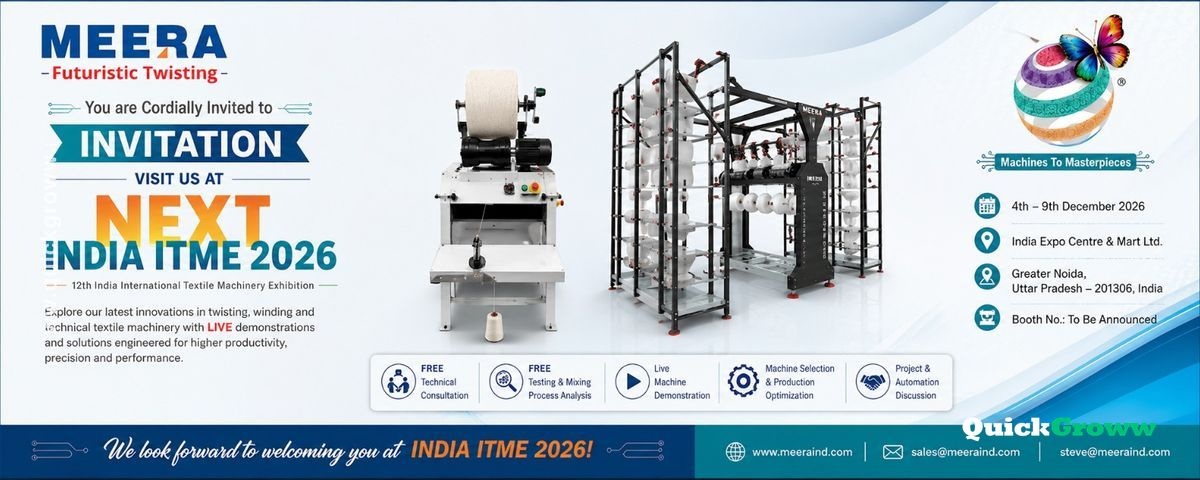
December is six months out. If you're a production head or plant manager in technical textiles, synthetic yarn, or high-performance fibre processing, that's enough time to plan one focused trip to Greater Noida.
INDIA ITME 2026 runs 4th to 9th December at the India Expo Centre & Mart Ltd., Greater Noida, Uttar Pradesh — 201306. It is India's largest textile machinery exhibition. Meera Industries Limited will be there with five machines running live on the show floor.
Not static displays. Not cutaway models. Running.
That distinction matters more than it sounds.
What "Live Running" Actually Means for Your Planning
A live machine at an exhibition tells you things a brochure cannot.
You see the package building in real time. You hear the tension under load. You watch how the traverse behaves at speed. If the yarn breaks, you see how the operator responds. If it doesn't break — at 200 MPM on 1000 denier — you have a data point that travels back to your plant with you.
Meera Industries is bringing five machines to INDIA ITME 2026, each configured to run specific yarn types. The lineup is not random. It covers the segment range that technical textile and specialty yarn producers deal with every day — from lab-scale cotton development all the way to 30,000 denier heavy denier processing.
Here is what will be running, and what each machine will be processing.
The Five Machines on the Floor
TPRX-50
The TPRX-50 will run cotton twine and 4000/3 PP thread. If you're in rope and twine manufacturing, or you run polypropylene thread for industrial sewing applications, this is the machine to stand beside for a few minutes. The signal from Meera describes it as designed for precision twisting with consistent yarn quality and high production efficiency — but the live run will show you what that means at the package level.
DTX-300 Digital Twister
This is the machine that will pull the crowd.
PP fibrillated yarn, 1000 denier yarn at 200 MPM, and HDPE yarn under the designation TPRS-25. Three yarn types. One machine. The 200 MPM speed on 1000 denier is the number that stands out here. If you're running polypropylene yarn or HDPE yarn in your facility and you've been benchmarking winding speeds, 200 MPM on that denier range is a reference point worth seeing in person.
The DTX-300 offers advanced digital control and tension management. What that means in practice — how the tension holds across the package, how the digital system responds to speed variation — is exactly what you can observe on 4th December rather than read about in a spec sheet.
CWX-250 Precision Winder
The CWX-250 will run Dyneema® yarn, aramid yarn, artificial grass yarn, and heavy denier yarns in the 25,000–30,000 denier range.
That denier range is where things get technically serious. Winding heavy denier yarn — 25,000 to 30,000 denier — requires precise traverse control. Package geometry at that count is unforgiving. If the traverse drifts, the package fails downstream. If the tension isn't consistent across the full width, you get hard edges and soft centers. Neither is acceptable in geotextile, webbing, or slings applications.
The fact that Meera is running Dyneema® and aramid on the same machine as heavy denier synthetic is notable. These are high-tenacity, high-value yarns. They don't forgive rough handling. Seeing the CWX-250 manage both within the same demonstration window tells you something about the tension control architecture.
If you process any of these yarn types — Dyneema®, aramid, artificial grass yarn, or heavy denier synthetics — the CWX-250 demonstration is the most application-specific thing you will see at INDIA ITME 2026.
R-200 Ring Twister
The R-200 will run technical textile yarns. Meera describes it as designed for demanding industrial applications requiring high strength, consistency, and performance.
Ring twisting remains the preferred method for a number of technical textile applications where yarn structure matters as much as throughput. The R-200 running live on technical textile yarns gives you a direct comparison point if your current line uses a different ring twister configuration. Watch the spindle, watch the package build, watch the doff preparation. These are the operational details that don't appear in any catalogue.
MST-165 Laboratory Twisting Machine
The MST-165 is the machine that often gets overlooked in favour of the higher-denier equipment. That's a mistake.
It runs cotton yarns and it's specifically positioned for R&D centres, universities, textile institutes, quality control laboratories, and production labs. If your organisation develops new yarn products before committing to commercial production — and if you've ever had a sample that looked right on paper and went wrong on the commercial line — the MST-165 addresses that gap directly.
Sample development and product testing before commercial production is the explicit use case. A live cotton yarn run at the exhibition gives R&D teams and lab managers a concrete reference for what precision sample twisting looks like at this scale.
The Booth as a Working Session
Meera's team at INDIA ITME 2026 will be available for free technical consultation and free twisting and winding process analysis. They'll also handle machine selection guidance, production optimisation discussions, project scoping, automation solutions, and machine trial consultations.
That is a specific list. It's not a marketing promise — it's a structured set of conversations that production heads, plant managers, and technical buyers can walk into with a defined problem and leave with a mapped solution.
If you are planning a new manufacturing facility, the six days of the exhibition give you access to engineering specialists who can discuss your production parameters against the machines running twenty feet away. If you are upgrading an existing production line — replacing older ring twisters, adding precision winding capacity, or moving into high-performance fibre processing — the show floor gives you a physical anchor for those discussions.
Bring your production data. Bring your denier range, your TPM requirements, your package size targets, your current spindle count. The conversation will be more specific and more useful if you come prepared.
Who Should Make the Trip
The signal from Meera explicitly addresses textile manufacturers, technical textile producers, yarn processors, researchers, engineers, production managers, OEMs, and exporters.
Let's be direct about which applications map most tightly to what will be running live.
Polypropylene and HDPE yarn producers — the DTX-300 running PP fibrillated yarn and HDPE yarn (TPRS-25) at 200 MPM is your benchmark.
Technical textile manufacturers working with high-performance fibres — the CWX-250 running Dyneema® and aramid is your reference point for precision winding at this yarn class.
Rope, twine, and PP thread manufacturers — the TPRX-50 running cotton twine and 4000/3 PP thread is running your yarn.
Heavy denier synthetic producers — the CWX-250 at 25,000–30,000 denier covers the upper end of what most winding machines handle in this segment.
R&D departments and textile institutes — the MST-165 running cotton yarns in a live lab demonstration is a direct window into sample-scale precision twisting.
Industrial technical textile producers — the R-200 ring twister running technical textile yarns in real time.
The exhibition runs six days. Most production heads will not spend all six there. But a single focused day — planned around which two or three machines map directly to your current production requirements — can compress months of remote specification work into a few hours of direct observation and conversation.
The Broader Pattern This Signals
Meera Industries is not bringing a generic showcase to INDIA ITME 2026. The machines on the floor map to specific, high-demand segments: heavy denier synthetic processing, high-performance fibre winding, PP and HDPE yarn twisting, and R&D-scale cotton development.
That specificity matters. The technical textile segment has fragmented considerably over the past decade. Geotextiles, artificial grass, Dyneema®-grade ropes, aramid-based safety products, PP-based sewing threads — these are not the same application. They have different denier ranges, different TPM requirements, different traverse and package demands. A manufacturer serving multiple segments needs machinery that can be configured or selected specifically for each.
Seeing five machines configured for five distinct application families on the same show floor — and having the engineering team available to discuss customisation beyond those configurations — is a practical answer to that fragmentation.
INDIA ITME happens once every four years in India. The next one is December 2026. That's the timeline.
Frequently Asked Questions
Q: Which machines will Meera Industries run live at INDIA ITME 2026?
A: Meera Industries will run five machines live: the TPRX-50, DTX-300 Digital Twister, CWX-250 Precision Winder, R-200 Ring Twister, and MST-165 Laboratory Twisting Machine. Each machine will process specific yarn types during live demonstrations on the show floor.
Q: What yarn types will the CWX-250 Precision Winder process at the exhibition?
A: The CWX-250 will run Dyneema® yarn, aramid yarn, artificial grass yarn, and heavy denier yarns in the 25,000–30,000 denier range during its live demonstration at INDIA ITME 2026.
Q: What speed will the DTX-300 Digital Twister demonstrate at the show?
A: The DTX-300 will process 1000 denier yarn at 200 MPM. It will also run PP fibrillated yarn and HDPE yarn (TPRS-25) during its live demonstration.
Q: What is the MST-165, and who is it designed for?
A: The MST-165 is a laboratory twisting machine that runs cotton yarns. It is designed for R&D centres, universities, textile institutes, quality control laboratories, and production labs — specifically for sample development and product testing before commercial production.
Q: What free services will Meera Industries offer at the booth during INDIA ITME 2026?
A: Meera's engineering and application specialists will offer free technical consultation and free twisting and winding process analysis. They will also provide machine selection guidance, production optimisation discussions, project scoping, automation solutions, and machine trial consultations across the six days of the exhibition.
INDIA ITME 2026. 4th to 9th December. India Expo Centre & Mart Ltd., Greater Noida, Uttar Pradesh — 201306. Five machines running live. If your application sits anywhere in the denier range or yarn type covered by those demonstrations, the question worth asking yourself now is: what production problem would you bring to that floor?