Yarn Reinforcement for Conveyor Belts and the Role of Meera's Twisting Technology
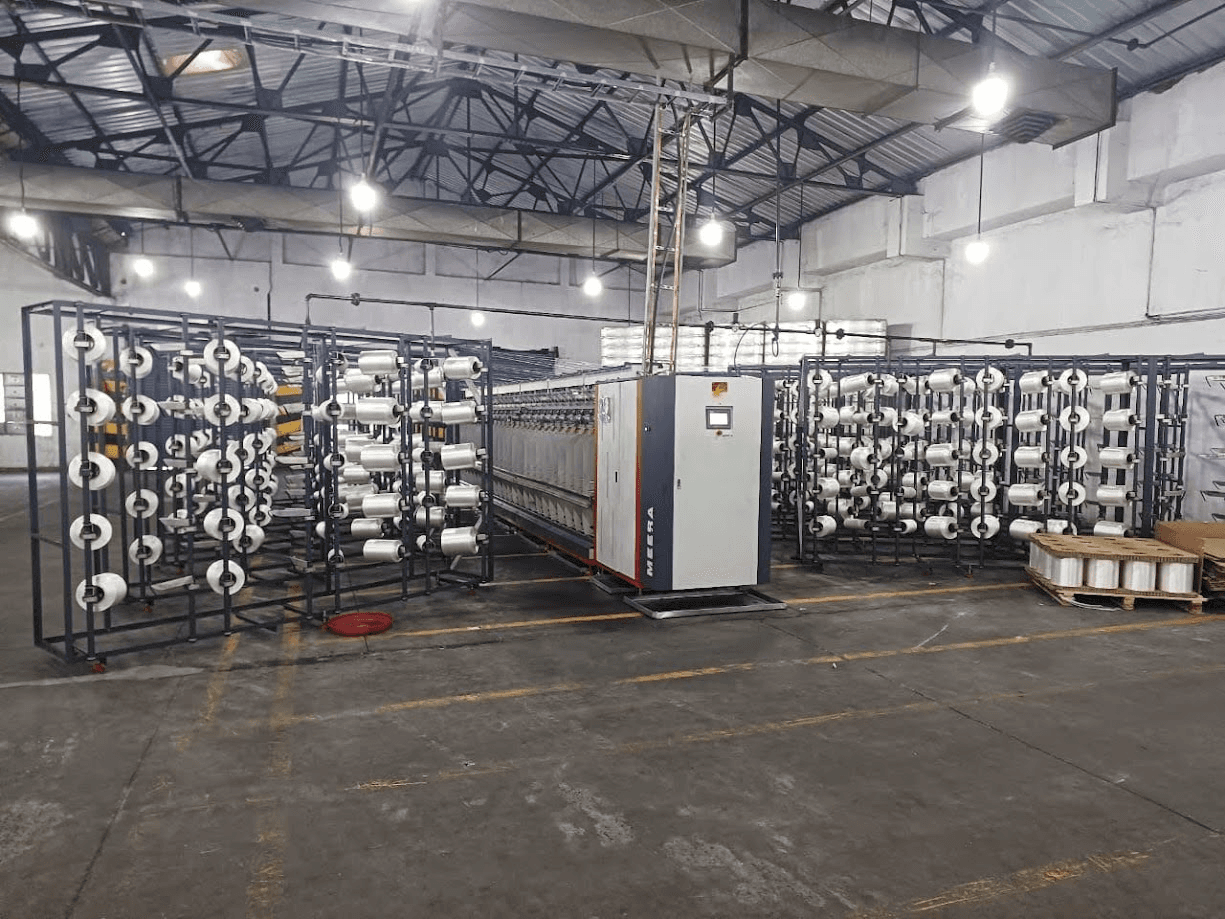
Conveyor belts must carry everything from coal and ore to cement, food and packaged goods over long distances, often under extreme conditions. The carcass (reinforcement) inside a belt determines its load-bearing capacity, elongation and resistance to ripping. Major belting fabric producers have long reinforced rubber belts with carefully engineered yarns and fabrics. Modern belts rely on high-tenacity synthetic fibres and sophisticated twisting technology to produce multi-ply yarns that deliver strength with low weight. Meera Industries, a leading supplier of twisting and cabling machinery, provides the equipment that enables these high-performance yarns.
1. What yarns are used in conveyor belts?
1.1 Polyester and nylon blends
Most textile conveyor belts use a combination of polyester and nylon (polyamide) yarns:
Polyester in the warp direction for high tensile strength and low stretch
Nylon in the weft direction for flexibility, small-pulley tracking, impact and tear resistance
High-tenacity grades of polyester and nylon are selected to achieve the required breaking strength, elongation and dimensional stability. The degree of twist, ply structure and yarn uniformity significantly influence the performance of the belt carcass.
Belting fabric classifications
Fabric type | Warp yarn | Weft yarn | Properties & Use |
EP (PN) | Polyester | Nylon 6.6 | High strength and low elongation; ideal for long-distance and heavy-duty belts |
NN (PP) | Nylon 6/6.6 | Nylon 6/6.6 | Superior elasticity, shock absorption and impact resistance |
EE | Polyester | Polyester | Very low elongation; excellent stability in both directions |
EN | Polyester | Nylon 6 | Balanced reinforcement with low warp stretch and high weft flexibility |
Straight-warp fabrics | Polyester, polyamide or aramid | Polyamide | Heavy warp yarns with floating weft for exceptional impact absorption; used in heavy-duty belts |
Aramid fabrics | Aramid & polyamide | Polyamide | High strength-to-weight ratio; used for ultra-light, high-performance belts |
Basalt fabrics | Basalt | Basalt | High fire and heat resistance for specialised applications |
These fabrics are typically dipped in RFL or similar adhesion systems to ensure strong bonding with rubber compounds. Variants include HMLS polyester, high-elongation weft polyester and monofilament constructions.
1.2 High-performance yarns and special fabrics
High-performance applications often require specialised fibres such as:
Aramid (Kevlar®)
UHMWPE (Dyneema®/Spectra®)
Basalt
Glass fibre
Steel cords
Straight-warp fabrics reinforced with aramid can replace both EP and steel-cord carcasses, offering benefits like lower rolling resistance, higher belt lifetime and reduced splice time. Kevlar breakers provide far greater cut resistance than traditional nylon breakers, while heavy straight-warp constructions provide rip resistance several times greater than conventional multi-ply belts.
1.3 Dipped cords and hoses
Some manufacturers also produce dipped single-end cords of:
Polyester
Nylon
Aramid
PVA
Rayon
These are used in conveyor belts, tyres, power-transmission belts and industrial hoses. Specialised dip solutions and heat treatments enhance adhesion, dimensional stability and fatigue resistance.
2. From Yarn to Belting Fabric – Twisting, Weaving and Treatment
Twisting and plying
Filaments are twisted into plied yarns to increase cohesion, strength and uniformity. The twist level determines the flexibility, stability and elongation of the final yarn.
Warping and weaving
Twisted yarns are warped and woven into fabrics using different weave structures such as plain, twill, broken twill, crowfoot and leno. Straight-warp constructions improve impact resistance by allowing floating weft yarns to absorb shock loads.
Dipping and finishing
Once woven, fabrics are dipped in RFL or alternative adhesive systems and heat-set to achieve specific shrinkage, modulus and bonding characteristics. Additional finishes include:
Rubber-friendly coatings
Rubber-repellent coatings
Flame-retardant finishes
Special coatings for temperature and chemical resistance
3. How Meera’s Twisting Technology Enables High-Performance Belting Yarns
3.1 Ring Twister – One-Step Plied Yarn Production
Meera Industries offers advanced Ring Twister machines specifically designed for technical yarns, including polyester, nylon, aramids, UHMWPE, basalt and glass.
Key features include:
Supports 100 to 100,000 deniers
Produces up to 24 plies in one step
Precision twist control for uniformity
Individual spindle motors for energy savings up to 40%
Delivery speeds up to 120 m/min
Integrated creels for multi-ply constructions
Automated break detection and spindle shutdown
Ring sizes from 140 mm to 300 mm to suit multiple yarn types
These capabilities enable manufacturers to create EP, NN, straight-warp and aramid constructions efficiently, consistently and with high productivity.
3.2 Other Twisting Solutions
Meera also supplies:
Double-Twist (TFO) machines for high-productivity cord production
TPRS one-step ply & reverse twisters for advanced multi-ply yarn making
Heavy-duty cablers for large-denier yarns used in geotextiles, hoses, carpet backing and industrial threads
All machines include automatic tension control, integrated creels and advanced monitoring systems to ensure consistent quality.
4. Industry Perspective and Major Players
(Including Meera’s Customer Base in This Segment)
The global conveyor-belt fabric and reinforcement industry is led by a handful of highly specialised manufacturers. SRF, Mehler, Shakti Cords and Fenner are among the leading players in this segment — and importantly, all four are long-standing customers of Meera Industries.
These companies manufacture:
EP, NN, EE and straight-warp belting fabrics
Aramid-reinforced lightweight composites
Dipped polyester, nylon and aramid cords for conveyor belts, tyres and hoses
High-tenacity yarn reinforcements for rubber products
Their production lines demand precision-twisted, high-tenacity yarns — one of the reasons they depend on Meera’s ring twisters, TFO twisters, TPRS machines and cablers.
Meera’s technology plays a critical role in enabling these top manufacturers to deliver reliable, high-performance conveyor-belt reinforcement materials used across mining, cement, steel, port handling, power, logistics, packaging and processing industries worldwide.
5. Conclusion
Yarn selection and twisting technology are fundamental to the performance of conveyor belts. Polyester and nylon dominate standard belting fabrics, while aramid, UHMWPE, basalt and other advanced fibres enable high-strength, lightweight and long-life solutions for demanding applications. Meera Industries’ twisting technologies provide the precision, consistency, energy efficiency and versatility required to manufacture these yarns at industrial scale.
By supporting up to 24-ply constructions, delivering uniform twist and enabling one-step plying, Meera’s twisting solutions ensure that belting-fabric and dipped-cord manufacturers can meet the exacting needs of their global customers — including industry leaders like SRF, Mehler, Shakti Cords and Fenner.
As industries demand stronger, lighter and more durable belts, the synergy between advanced fibres and Meera’s precision twisting will continue to drive the next generation of conveyor-belt technologies.
6. Contact Details
Meera Industries Limited
📞 Mobile: +91 9898046636
📞 Phone: +91 261 2399114
📧 Email: [email protected]
📍 Address: 2126, Road No. 2, GIDC, Sachin, Surat, Gujarat – 394230
Our engineers will help you select the ideal twisting solution — Ring Twister, TFO, TPRS or Cabler — for producing the perfect reinforcement yarns for EP, NN, EE, straight-warp, aramid or UHMWPE-based conveyor belts.