From Fibre to Field: Meera Twisting Machines Power India’s Next-Gen Geotextiles
The geosynthetics industry has moved from niche to necessity. Once used mainly for simple filtration and separation, geotextiles and related geosynthetic products now sit at the heart of sustainable infrastructure—highways, rail corridors, coastal protection, landfills, riverbanks, mining, and smart cities.
Recent editorial insights from Mr Narendra Dalmia (Strata Geosystems) highlight how India’s geosynthetics ecosystem is shifting from manufacturing-led growth to engineering-led innovation. The Indian geotech market was valued at around ₹2,397 crore in 2021 and is projected to reach about ₹4,483 crore by FY 2024-25, a strong CAGR of nearly 17%. Exports are rising, imports are still significant, and applications are becoming more demanding.
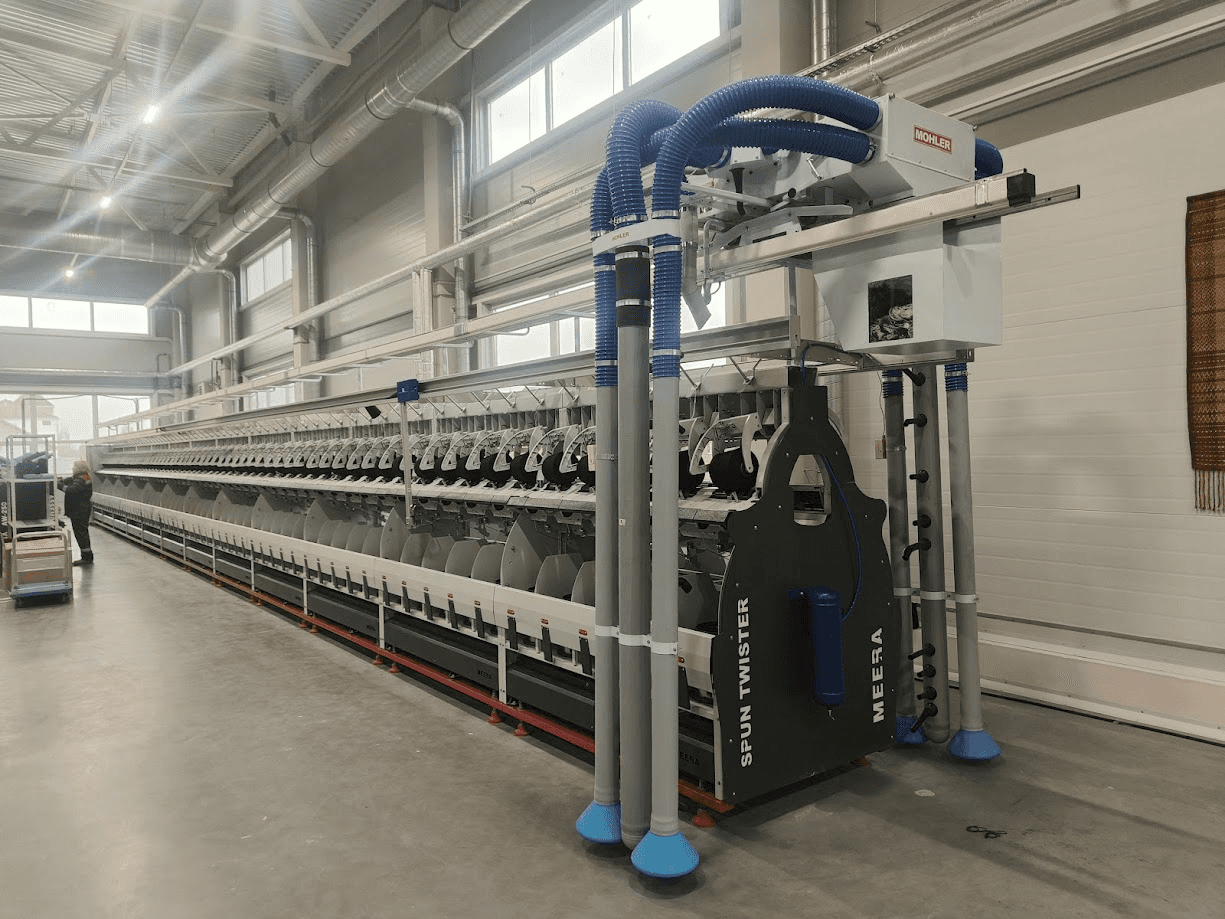
Behind every successful geogrid, geobag, geocell, or drainage composite is engineered yarn – twisted, cabled, and wound with precision. That is exactly where Meera Industries Limited becomes a technology partner for the industry.
Our flagship machines – DTX-300, TPRS-25, CWX-250 and R-200 – are designed for high-tenacity polyester, polypropylene and specialty yarns used across the geosynthetics value chain.
Why Yarn Engineering Matters in Geosynthetics
Geosynthetics such as geogrids, geotextiles, drainage composites, geobags, geotubes and erosion control mats rely on:
High tensile strength to resist loads from soil, traffic and water
Controlled elongation to avoid rutting and settlement
Long-term durability under UV, chemical and biological exposure
Dimensional stability so fabrics stay flat during weaving, needling or thermo-bonding
These properties start at the fibre and yarn level. The industry is progressively moving towards:
High-tenacity PET and PP multifilament yarns
Low-shrinkage and low-creep industrial yarns
Aramid and high-modulus fibres for extreme reinforcement
Recycled and bio-based polymers for sustainable projects
Natural fibres such as jute and coir in erosion control mats and certain geobags
Consistent yarn twist, balanced S/Z plying and uniform winding tension ensure that woven, knitted or nonwoven geotextiles meet stringent BIS, ASTM, ISO and EN standards.
Overview of India’s Key Geosynthetic Segments
Industry leaders such as Shri Gautam Dalmia (Strata Geosystems), Shri Saurabh Vyas and Shri Rajendra Ghadge (TechFab and Garware) and Shri Aditya Agarwal (Jeevan Ecotex) describe a rapidly evolving landscape:
Geogrids:
Indian market ~₹800–1,000 crore, supported by 8–10% growth in infrastructure.
Global market estimated at ₹4,000–5,000 crore.
Used in rail and road reinforcement, retaining walls and embankments.
Raw materials: high-tenacity PET and PP yarns or extruded ribs.
Drainage Composites & PVDs (Prefabricated Vertical Drains):
Global drainage composite market ~USD 1.5 billion (2023), expected to grow with a CAGR of ~7–8%.
PVDs alone are valued at roughly USD 180–190 million, with applications in soft soil improvement, embankments and reclamation.
Require core and filter layers made from PP/PE and nonwoven geotextiles.
Geobags, Geotubes & Erosion Control Mats:
Used for riverbank and coastal protection, flood control, dune restoration and shoreline stabilization.
Materials range from PP/PET woven fabrics to biodegradable jute and coir.
Geocells & Geotextiles:
Geocells market is forecast to grow from about USD 160 million in 2025 to over USD 280 million by 2035, at ~5–6% CAGR.
Geotextiles in India are already around ₹1,000 crore and could reach ₹10,000 crore if fully adopted in roads and railways.
Across these segments, yarns are expected to deliver high strength, low creep, chemical resistance and long design life – often 50–100 years. That level of performance is impossible without precise twisting and winding technology.
Meera’s Twisting Technology for Geotextile-Grade Yarns
DTX-300 – High-Speed Direct Cabler for Heavy Denier Yarns
The DTX-300 is Meera’s workhorse for 210–6,000 denier polyester and polypropylene industrial yarns used in:
Uniaxial, biaxial and multiaxial geogrids
High-strength woven geotextiles
Geobags and geotubes for coastal and riverbank protection
Key advantages for geotextile producers:
High take-up package weight for long weaving runs and minimal doffs
Stable twist for low-creep reinforcement yarns
Electronic tension control to reduce yarn damage and variation
Suitable for both single and multi-ply cabling
By delivering balanced S/Z constructions and consistent twist across every position, DTX-300 ensures that grid ribs and woven fabrics maintain design modulus and junction efficiency even under harsh field conditions.
TPRS-25 – One-Step Ply & Cable Twister for Efficient Production
Many geosynthetic constructions such as separation geotextiles, reinforcement fabrics and stitching threads for geobags require multi-ply yarns with specific S/Z combinations.
The TPRS-25 combines twisting, plying and reverse twisting in a single pass:
Ideal for 500/2, 1000/2, 1000/3 and other constructions in PET and PP
Reduces energy, floor space and labour compared to multi-step routes
Helps maintain twist balance, preventing snarling and shrinkage during weaving or needle-punching
For manufacturers scaling up to meet road, rail and coastal protection tenders, TPRS-25 unlocks fast, repeatable, and cost-efficient production of reinforcement and sewing yarns.
CWX-250 – Precision Winder for Technical Yarn Packages
Downstream warp beams, weft packages, knitting cones or PVD core yarns demand perfectly formed packages. The CWX-250 precision winder provides:
Electronic traverse for customizable winding patterns
Uniform density to avoid dyeing and impregnation issues
Capability to handle large package weights for long running times
Integration with tension and length monitoring for quality assurance
Whether you are winding yarns for drainage composites, geocells, erosion control mats or nonwoven feedstock, CWX-250 acts as the final quality gate before fabric formation.
R-200 – Ring Twister for Versatile Geotextile Yarns
The R-200 ring twisting machine is widely used for:
Fine to medium denier PP and PET industrial yarns
Thermally bonded nonwoven feed yarns
Natural fibre yarns such as jute and coir for erosion control and biodegradable geobags
With adjustable twist range, robust ring frames and engineered drafting systems, R-200 ensures:
Low hairiness and uniform twist, crucial for filtration and separation roles
Consistent performance when fabrics are subjected to UV, abrasion and chemical exposure
Compatibility with recycled and bio-based polymers, supporting sustainability targets
Matching Yarn Types to Geosynthetic Applications
Below is a simplified mapping of yarn types, applications and relevant Meera machines:
High-tenacity PET/PP multifilament yarns
Applications: geogrids, woven geotextiles, geobags, geotubes, geocells
Machines: DTX-300 (cabling), TPRS-25 (multi-ply), CWX-250 (precision winding)
PP monofilament / tape yarns
Applications: needle-punched nonwovens, drainage composites, erosion control mats
Machines: R-200 (ring twisting), CWX-250 (rewinding and warping packages)
Core yarns for Prefabricated Vertical Drains (PVDs)
Applications: soft soil consolidation for ports, refineries, embankments
Machines: DTX-300 / R-200, followed by CWX-250
Natural fibres (jute, coir) for eco-friendly products
Applications: erosion control blankets, biodegradable geobags
Machines: R-200 for yarn preparation; CWX-250 for package building
Specialty fibres (aramids, high-modulus yarns)
Applications: high-strength reinforcement zones, critical rail and highway structures
Machines: DTX-300 and TPRS-25 for controlled high-twist constructions
This integrated machinery platform allows Indian manufacturers to respond quickly to BIS/IRC/MORTH specifications, international standards (ASTM, ISO, EN) and demanding project-specific requirements.
Why Choose Meera as Your Geotextile Technology Partner?
Deep Technical Understanding
Meera machines are engineered specifically for technical yarns, not just apparel. Features like servo-based drives, electronic traverse, online tension monitoring and Industry 4.0-ready controls support precision critical to geosynthetics.
Flexibility for Multiple Product Lines
With the same twisting and winding assets, mills can serve geogrids, geotextiles, industrial sewing threads, ropes and webbings, maximizing utilization.Alignment with Standards & Testing Needs
Indian labs—BIS-recognized and NABL-accredited—now test for tensile strength, creep, filtration, discharge capacity and durability. Our yarn engineering support helps customers hit these performance windows consistently.Future-Ready for Smart & Sustainable Geosynthetics
As experts like Shri Upadhyay Kalpesh Kumar and Shri Aditya Agarwal highlight, trends include stress-sensing geogrids, bio-based components and recycled polymers. Meera’s R&D teams continuously adapt machine platforms for new materials and hybrid constructions.Make-in-India Advantage
Local manufacturing, service support and spares mean short lead times, lower lifecycle costs and faster project execution—critical when working on time-bound highway, metro and coastal protection projects.
FAQ – Geotextile Yarn & Twisting for Geosynthetics
Q. What is a geotextile?
A geotextile is a permeable textile (woven, knitted, nonwoven or knitted-weft-inserted) used in contact with soil or rock for functions such as separation, filtration, drainage, reinforcement and protection.
Q. What is the difference between geotextiles and geogrids?
Geotextiles are continuous fabrics performing filtration, separation and reinforcement.
Geogrids are grid-like structures with open apertures used primarily for reinforcement, providing high tensile stiffness in one or two directions.
Q. Why is yarn twist important for geotextiles?
Twist controls strength, elongation, abrasion resistance and dimensional stability. Too little twist causes filament slippage; too much twist reduces modulus. Machines like DTX-300, TPRS-25 and R-200 allow precise setting of twist per metre for different applications.
Q. Which polymers are most common in geotextile yarns?
The main polymers are polyester (PET) and polypropylene (PP) for their high tenacity, chemical resistance and cost-effectiveness. For certain applications, HDPE/LLDPE, aramids, jute and coir are also used.
Q. What is a Prefabricated Vertical Drain (PVD)?
A PVD is a composite drain consisting of a plastic core wrapped in a geotextile filter, installed in soft soils to accelerate consolidation by providing short drainage paths.
Q. How do precision winders like CWX-250 impact geosynthetic quality?
Precision winders ensure uniform package density, controlled tension and clean edges, which reduce yarn breaks, improve fabric uniformity and enable consistent impregnation or coating in downstream processes.
Q. Can Meera machines handle recycled and bio-based polymers?
Yes. With appropriate process settings (tension, twist, speed and temperature), Meera twisting and winding machines can process recycled PET/PP and bio-based fibres, helping manufacturers meet sustainability and ESG goals.