The Complete Guide to Monofilament Yarns & Why Meera Industries Is the Preferred Partner for High-Performance Twisting Solutions
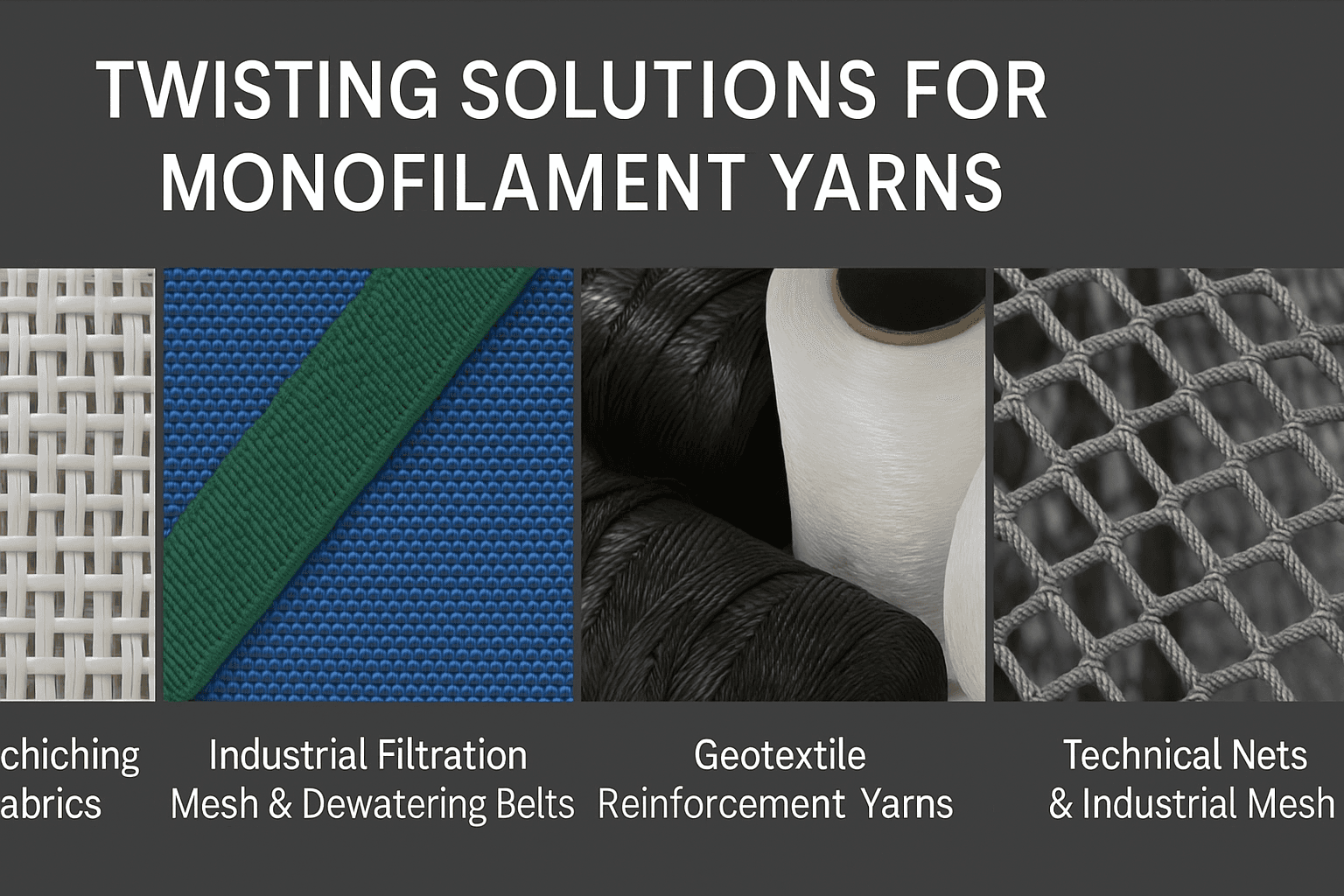
Monofilament yarns have become the backbone of modern technical textiles—powering industries such as paper machine clothing (PMC), filtration, automotive, geotextiles, medical textiles, agrotech, outdoor nets, belts, and industrial reinforcement fabrics. As global demand for engineered performance yarns increases, manufacturers require precise, consistent and reliable twisting technology to deliver high-quality monofilament products.
Meera Industries, with its advanced range of twisting machines such as TPRS-50, R-200 Ring Twister, and One-Step Compound Twister, empowers manufacturers worldwide to produce single-twist, ply-twist, and cable-twist monofilament yarns with unmatched reliability and productivity.
1. What Are Monofilament Yarns?
Monofilaments are single, continuous filaments extruded from high-performance polymers. These yarns offer:
High tensile strength
Abrasion resistance
Dimensional stability
Chemical and temperature resistance
They are engineered using polymers such as:
Monofilament Yarn Types (Complete List)
Polyester (PET) Monofilament
Polyamide 6 & 6.6 (Nylon)
Polypropylene (PP) Monofilament
High-Density PE & UHMWPE Monofilament
Polybutylene Terephthalate (PBT) Monofilament
PEEK, PPS & PTFE High-Performance Monofilaments
Textured, High-Tenacity & Low-Shrinkage Monofilaments
Hydrolysis-Resistant & UV-Stabilised Monofilaments
These properties make monofilaments ideal for technical fabrics that operate under tension, water flow, pressure, abrasion or mechanical load.
2. Products Made Using Monofilament Yarns
A. Paper Machine Clothing (PMC)
Forming fabrics
Press fabrics
Dryer screens
Spiral link belts
B. Industrial Filtration
Dewatering belts
Screen printing meshes
Air & liquid filter fabrics
C. Automotive & Transportation
Airbag reinforcement
Seat-support mesh
Hose reinforcement layer
Timing belts
D. Technical Industrial Fabrics
Conveyor belt carcass reinforcement
Geotextile fabric structure
Safety webbing reinforcement
Technical meshes & nets
E. Household & Consumer Goods
Fishing line
Bristles & brushes
Mesh bags
Sporting nets
F. Medical & Hygiene
Monofilament sutures
Dental floss
Medical mesh
G. Agriculture & Outdoor
Shade nets
Anti-hail nets
Aquaculture nets
Greenhouse screens
Monofilament yarns must be twisted precisely to enhance tensile properties, flexibility, and fatigue resistance—making the role of twisting machinery crucial.
3. Why Twisting Is Critical for Monofilament Yarns
Twisting enhances:
Strength & durability
Flexibility and bending resistance
Uniformity across fabric structures
Abrasion & fatigue resistance
Thermal and mechanical stability
Industries like PMC, filtration, and automotive belts demand uniform twist levels (TPM/TPI) and consistent yarn tension—precisely what Meera’s machines deliver.
4. Meera Industries: The Technology Leader for Monofilament Twisting
A. TPRS-50 – One-Step Ply & Cable Twister
The TPRS (Twisting, Plying & Reverse Twisting System) is Meera’s flagship innovation. It performs:
Single Twisting
Ply Twisting
Cable Twisting
Reverse Twisting (S/Z)
in one continuous process.
Perfect for:
PMC monofilament ply structures
Geotextile reinforcements
Automotive belts
High-strength meshes
Benefits:
50–70% savings in floor space
No intermediate rewinding
High energy efficiency
Lowest manpower requirements
B. R-200 High-Speed Ring Twister
Ideal for high-tenacity monofilament twisting where:
High TPM
Uniform twist
Zero hairiness
Perfect package build
are mandatory.
Used for:
Industrial mesh
Filtration fabrics
Automotive reinforcement yarns
Technical nets & ropes
C. One-Step Compound Twister
Designed for large denier monofilament:
300–10,000 denier
Single twist + ply twist in one flow
Suitable for stiffer yarns like PET, PEEK, Nylon
Applications:
Conveyor belts
Dewatering belts
Ropes & geotextiles
PMC dryer fabrics
5. Global Companies Involved in Monofilament Yarn Twisting
These companies twist monofilament yarns or manufacture monofilament technical fabrics:
1. Monosuisse Group – Switzerland / Germany
High-precision monofilament leader for PMC, filtration & automotive.
2. Perlon Group – Germany
Producers of monofilaments for filtration, paper, composites & medical use.
3. Jarden / Shakespeare Company – USA
Major producers of fishing-line monofilament & industrial mono yarns.
4. Nextrusion / Nextrusion Group – Europe
Technical monofilaments for industrial fabrics and screen meshes.
5. Supreme Tex / Garware Technical Fibres – India
Monofilament nets, ropes, aquaculture and sporting mesh manufacturers.
(These companies use or require twisting, cabling, or plying monofilament yarns for various technical applications.)
6. Why Meera is the Best Machinery Partner for Monofilament Manufacturers
Global installations across technical textile sectors
Industry 4.0-ready machines (optional)
Low energy consumption, high output
Machines suitable for PET, PA6, PA66, PP, PEEK, PBT monofilaments
Trusted by major technical textile companies worldwide
Whether you are producing PMC fabrics, geotextiles, filtration media or automotive belts, Meera offers a complete portfolio of single-twist, ply-twist, and cable-twist technologies.
Frequently Asked Questions (FAQ)
Q. Can monofilament yarns be twisted like normal multifilament yarns?
Yes. Meera machines are engineered specifically to handle stiffer, larger-denier monofilaments with controlled tension.
Q. What TPM range is possible for monofilament twisting?
Depending on denier, 30–450 TPM is common.
Machines like R-200 can achieve even higher precision TPM.
Q. Which Meera machine is ideal for monofilament used in PMC?
The TPRS-50 and One-Step Compound Twister are most suitable due to their ability to twist and ply in one go.
Q. What is the typical denier of monofilaments used in industrial applications?
Ranges from 150 denier up to 12,000 denier, depending on application.
Q. Can Meera provide turnkey support?
Yes—Meera provides:
Machine selection
Technical consultation
Spare parts
After-sales support
Partner with Meera for Your Monofilament Twisting Requirements
Whether you're producing paper machine fabrics, geotextiles, filtration belts, safety webbings, medical monofilament, or industrial meshes, Meera Industries is your trusted, globally proven technology partner.
👉 Contact Us:
📧 [email protected]
🌐 www.meeraind.com
📞 +91-261-2399112
Meera Industries – SmartPower. SmartOutput. SmartUser. Your technical textile machinery partner for the next decade and beyond.