Engineering India’s PROTECH Revolution: Technical Yarns, Flame-Retardant Fibres & the Emerging Role of Advanced Yarn Covering Technologies By MEERA
India’s progress in Technical Textiles, especially within the PROTECH (Protective Textiles) vertical, has accelerated dramatically over the last few years. Catalyzed by the Ministry of Textiles’ National Technical Textiles Mission (NTTM), the sector has moved beyond basic industrial fabrics into high-performance areas such as fire proximity suits, structural firefighting gear, thermal-protective composites, and inherent flame-retardant fibres.
These developments have not only redefined India’s capabilities but have also positioned the country as a serious global contender in specialized protective applications—traditionally dominated by imported materials and technologies.
A closer look at recent milestones reveals a consistent theme:
the success of advanced protective textiles is fundamentally rooted in the quality of technical yarns.
Whether it is an aluminized fire-entry suit or a multi-layer FR fabric for industrial safety, the underlying yarn structure—its twist, covering integrity, core-sheath engineering, denier balance, and thermal performance—determines the reliability of the final product.
This article explores India’s latest breakthroughs in firefighting protective gear, the science behind inherent flame-retardant (IFR) fibres, the trade dynamics of industrial textiles, and the evolving role of advanced yarn-processing systems such as covering, twisting, and cabling in supporting this transformation. It aims to give the PROTECH ecosystem a consolidated lens on material science, fibre behavior, yarn engineering, and the technology required to manufacture performance-driven protective textiles.
India’s Leap in Protective Textiles: Fire Proximity Suit Innovation
A landmark in India’s PROTECH journey was the development of an indigenously manufactured aluminized fire proximity suit, spearheaded by the Ministry of Textiles and executed in collaboration with NITRA and an industry partner. Designed for high-temperature industrial environments—including oil & gas, structural firefighting, and hazardous response applications—these suits represent a major shift from dependence on imported protective gear.
Industry Requirements Addressed:
Resistance to radiant and convective heat
Protection against flame engulfment
Structural durability during short-duration fire entry
Conformity to international standards such as EN 1486, ISO 11612, ISO 13506, ISO 15538
Comfort and ease of donning, reinforced with user-centric design thinking
A key differentiator in the suit’s performance is its dual-layered construction, combining advanced reflective laminates with high-performance technical yarns. These yarns must withstand intense thermal shocks, mechanical load, and prolonged exposure to high heat—all without structural collapse.
This is where the importance of engineered technical yarns becomes critical.
Technical Yarns: The Structural Backbone of Fire-Resistant Fabrics
Protective textile fabrics derive their performance from the micro-engineering inside the yarn. Uniform twist insertion, multi-ply balance, core-sheath structures, and fibre compatibility all contribute to heat resistance, stability, and durability.
Yarns used in PROTECH applications commonly utilize fibres such as:
PBO (Polybenzoxazole)
Meta-aramid
Para-aramid
Modacrylic FR
FR Viscose
UHMWPE (as a core filament)
ABPBI and Polyacrylate
Glass fibre (structural reinforcement)
Each of these fibres behaves differently under heat, as demonstrated in thermal-shrinkage studies conducted at 180°C for 30 minutes. The results highlight the criticality of yarn design:
PBO:
Lowest weight loss
Negligible shrinkage
Maintains structural integrity
Ideal for outer-layer heat barriers
Excellent for composite reinforcement
Meta-Aramid:
Strong heat resistance
Minimal physical deformation
Suitable for mid-layer protection
Para-Aramid:
High tensile strength
Balanced heat performance
Preferred for reinforcement yarns in fire suits
Modacrylic FR:
Flame suppressant characteristics
Performs best in blends with aramids
FR Viscose:
Provides comfort and moisture management
Works as an inner thermal layer
UHMWPE:
High strength
Poor high-heat performance
Effective when used as core yarn covered with high-temperature sheaths
Polyacrylate & ABPBI:
Exceptional high-heat endurance
Good for specialty applications in extreme environments
The combination of these fibres, engineered into consistent yarn structures, creates the building blocks for multi-layered protective apparel.
The Role of Yarn Engineering in PROTECH: Why Covering & Twisting Matter
Advanced protective textiles typically incorporate:
Core-sheath yarns
Dual-covered multi-layer yarns
Blended protective yarns
Reinforcement yarns with high-tenacity cores
Hybrid structures (Glass/Aramid, UHMWPE/Aramid)
To achieve these constructions, manufacturers rely on high-precision yarn-processing systems.
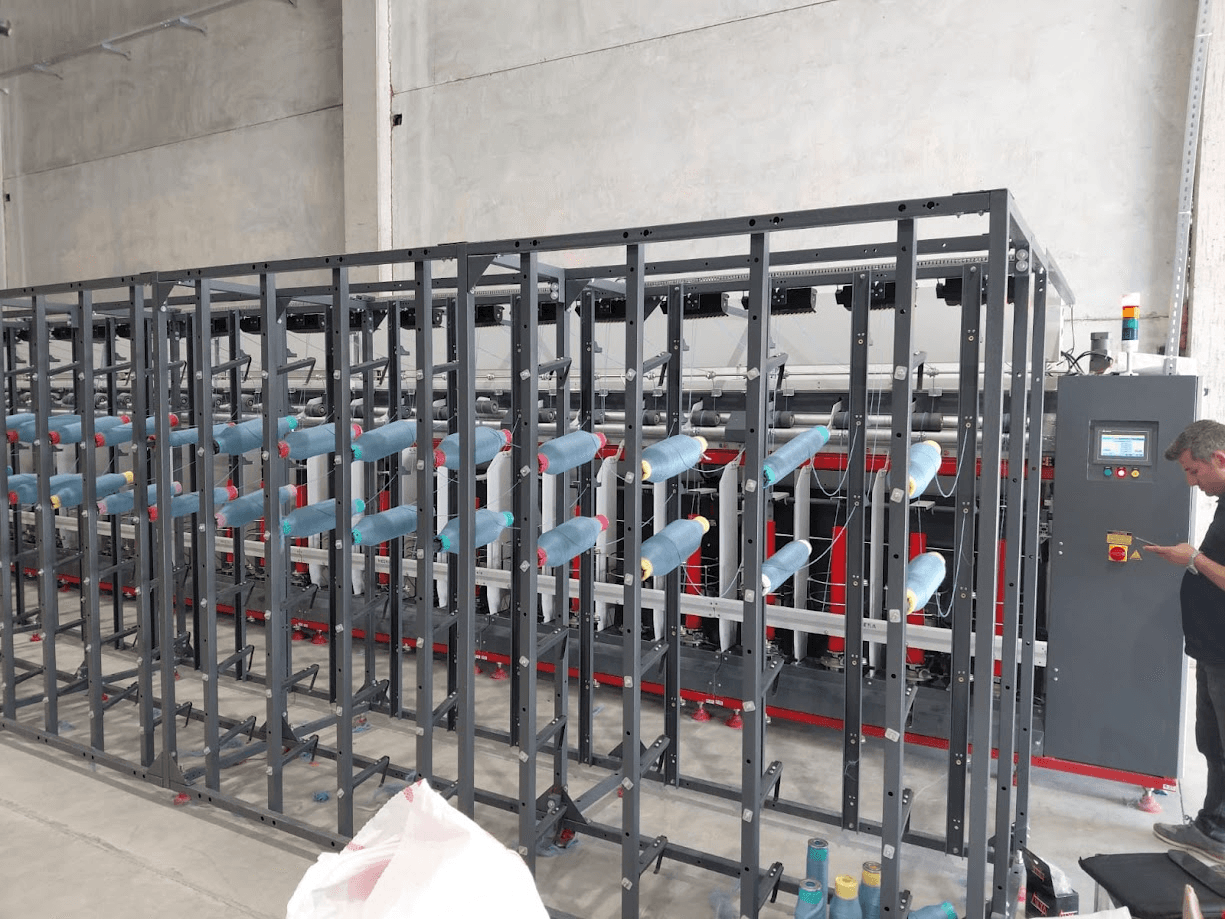
A modern Covering Machine designed for technical fibres (such as the one used for producing Lycra-covered, glass-covered, or aramid-covered yarns) provides four critical engineering advantages:
1. Multi-Stage Covering Enables Hybrid Protective Yarn Structures
A typical dual-covering system includes:
Core yarn feed for glass, aramid, UHMWPE, or elastic filaments
First covering spindle for base twist
Second covering spindle for stability twist
Final take-up for consistent package formation
This architecture supports technical structures like:
Glass fibre core + aramid sheath
UHMWPE core + para-aramid sheath
Modacrylic/Para-aramid blends
FR viscose with aramid reinforcement
These multi-layer yarns are essential for products requiring:
High heat resistance
Minimal shrinkage
Enhanced structural cohesion
Balanced mechanical properties
2. High Spindle Speeds & Denier Flexibility for PROTECH Yarns
Technical protective yarns often require precise twist insertion across a wide denier range.
A covering system capable of:
16000 RPM spindle speed
50–6000 denier core capacity
50–1000 denier covering capacity
Twist range of 150 to 4500 TPM
ensures uniformity and performance repeatability—the backbone of reliable FR fabrics.
3. Core-Sheath Bonding for Fire-Resistant Applications
A critical requirement in FR textiles is the interfacial bonding between the core and covering layer.
Technologies such as:
Hollow spindle design
Controlled elongation systems
Sophisticated traverse & tapering devices
Lip-motion systems for perfect winding geometry
allow technical yarns to achieve:
Balanced twist
Zero-defect surface characteristics
High weaving/knitting efficiency
This level of consistency is required for NFPA, EN, and ISO compliant protective fabrics.
4. Real-Time Quality Protection with Sensor-Based Breakage Control
In protective textiles, a single weak spot in the yarn structure can result in fabric failure during fire exposure.
Advanced covering systems use:
Sensor cutters at every position
Automated break detection at core, first twist, and second twist
ensuring that defective yarn is eliminated instantly, maintaining product integrity.
Inherent Flame-Retardant Fibres: Understanding Thermal Degradation
The thermal-shrinkage study on IFR fibres provides essential insight for yarn manufacturers. For example:
PBO and ABPBI show minimal degradation, making them ideal for outer heat-exposure layers.
Meta-aramid and para-aramid maintain structural integrity even after exposure.
FR viscose shows controlled shrinkage, making it suitable for comfort layers.
UHMWPE melts and drips, limiting its use to core applications where it is protected by high-performance sheaths.
These behaviors must be considered during:
Pre-yarn evaluation
Yarn blending
Twist design
Covering-layer selection
Fabric construction
A systematic approach to fibre-level understanding directly improves protective textile reliability.
India’s Industrial Textile Landscape: Why High-Performance Yarns Matter
According to the Ministry of Commerce & Industry data:
FY 2024-25 Indutech exports: INR 3058 crores
Indutech imports: INR 3721 crores
Key exported items include:
Narrow woven fabrics
Glass fibre materials
Technical yarns
India still imports large volumes of advanced technical filaments and FR fibres, indicating a significant growth opportunity for domestic yarn engineering and conversion.
As global demand for PROTECH materials continues to rise—with applications in firefighting, defence, industrial safety, auto textiles, and aerospace—India’s ability to convert advanced fibres into high-performance yarns will define its competitive advantage.
Applications Enabled by Advanced Technical Yarns in PROTECH
1. Fire & Heat-Protective Clothing
Aluminized fire proximity suits
Structural firefighting suits
Foundry worker protective wear
2. Industrial Safety Equipment
Cut-resistant gloves
Heat-shield fabrics
Welding protective blankets
3. Composite Reinforcements
Glass-aramid hybrid reinforcement
PBO-based structural composites
4. High-Temperature Insulation
Thermal liners
FR inner fabrics
Engine insulation barriers
Each of these applications relies on precision-engineered yarns produced from a combination of aramid, PBO, modacrylic, FR viscose, polyacrylate, glass fibre, or UHMWPE.
India’s Path Forward: Building a Strong PROTECH Ecosystem
India’s transition from fabric importer to global protective textile supplier is already underway. But the next leap requires:
Stronger collaboration between fibre suppliers, textile mills, and yarn converters
Greater investment in high-performance yarn engineering
A national push toward self-sufficiency in aramid, PBO, and high-temperature fibre production
Wider adoption of precision covering and twisting technologies
Standardised testing aligned with NFPA, ISO, EN requirements
As manufacturers adopt state-of-the-art yarn-processing systems and blend them with India’s indigenous fibre innovations, the PROTECH sector is set to achieve remarkable growth—serving both domestic needs and global markets.
Conclusion
The evolution of India’s protective textiles industry is anchored in a deeper understanding of material science, thermal behavior, and yarn engineering. As new fibres such as PBO, meta-aramid, FR viscose, and polyacrylate continue to reshape the landscape, the role of precision technical-yarn machinery becomes even more essential.
Covering, twisting, core-sheath structuring, controlled tensioning, and advanced spindle systems now sit at the heart of modern PROTECH manufacturing. These technologies enable Indian mills to convert high-performance fibres into reliable, standard-compliant protective yarns that power firefighting suits, industrial protection gear, thermal insulation fabrics, and composite reinforcements.
The PROTECH vertical is now one of the fastest-growing segments in India’s technical textile mission—and through stronger engineering, deeper collaboration, and enhanced
FAQs
Q. What are the key yarns used in fire proximity suits?
Fire proximity suits typically use technical yarns made from para-aramid, meta-aramid, PBO, modacrylic FR, FR viscose, and hybrid structures such as aramid-glass composite yarns. These yarns deliver the heat resistance, mechanical stability, and flame-retardant performance essential for fire-entry applications.
Q. Why is yarn covering important for protective textiles?
Covering is critical because it creates core-sheath structures that improve heat stability, reduce shrinkage, enhance flame resistance, and maintain mechanical integrity during thermal exposure. In PROTECH applications, covering helps combine multiple fibre properties into a single high-performance yarn.
Q. How do inherent flame-retardant fibres behave under heat?
Fibres like PBO, para-aramid, and meta-aramid show excellent heat resistance with minimal shrinkage. Modacrylic FR provides flame suppression, while FR viscose offers moisture management. UHMWPE has high strength but melts under extreme heat, making it suitable only as a core protected by a high-temperature sheath.
Q. What machinery is used to produce technical yarns for PROTECH?
Technical yarns are produced using specialized systems such as covering machines, twisting machines, cablers, and assembly winders. These machines ensure controlled twist, consistent core-sheath bonding, uniform denier stability, and precision winding—crucial for fire-safe and FR textile applications.
Q. Which technical textile segment do fire-resistant fabrics belong to?
Fire-resistant, flame-retardant, and thermal-protective fabrics belong to the PROTECH (Protective Textiles) segment, one of the key verticals under India’s National Technical Textiles Mission. PROTECH focuses on materials used for personal and industrial safety.
Q. Can UHMWPE fibres be used in high-temperature protective clothing?
UHMWPE cannot be used alone for high-temperature FR clothing because it melts and drips under heat. However, it performs exceptionally well when used as a core yarn covered with aramid or other high-heat fibres, enhancing cut and abrasion resistance while protecting the core from thermal degradation.
Q. Why are hybrid yarns important for modern protective textiles?
Hybrid yarns combine the strengths of multiple fibres—such as aramid strength, modacrylic flame suppression, and FR viscose comfort—to create materials optimized for multi-hazard environments. Their engineered layers help deliver superior thermal stability, durability, comfort, and compliance with global fire-safety standards.