Why Leading Twine and Rope Manufacturers Trust Meera's Twisting Technology
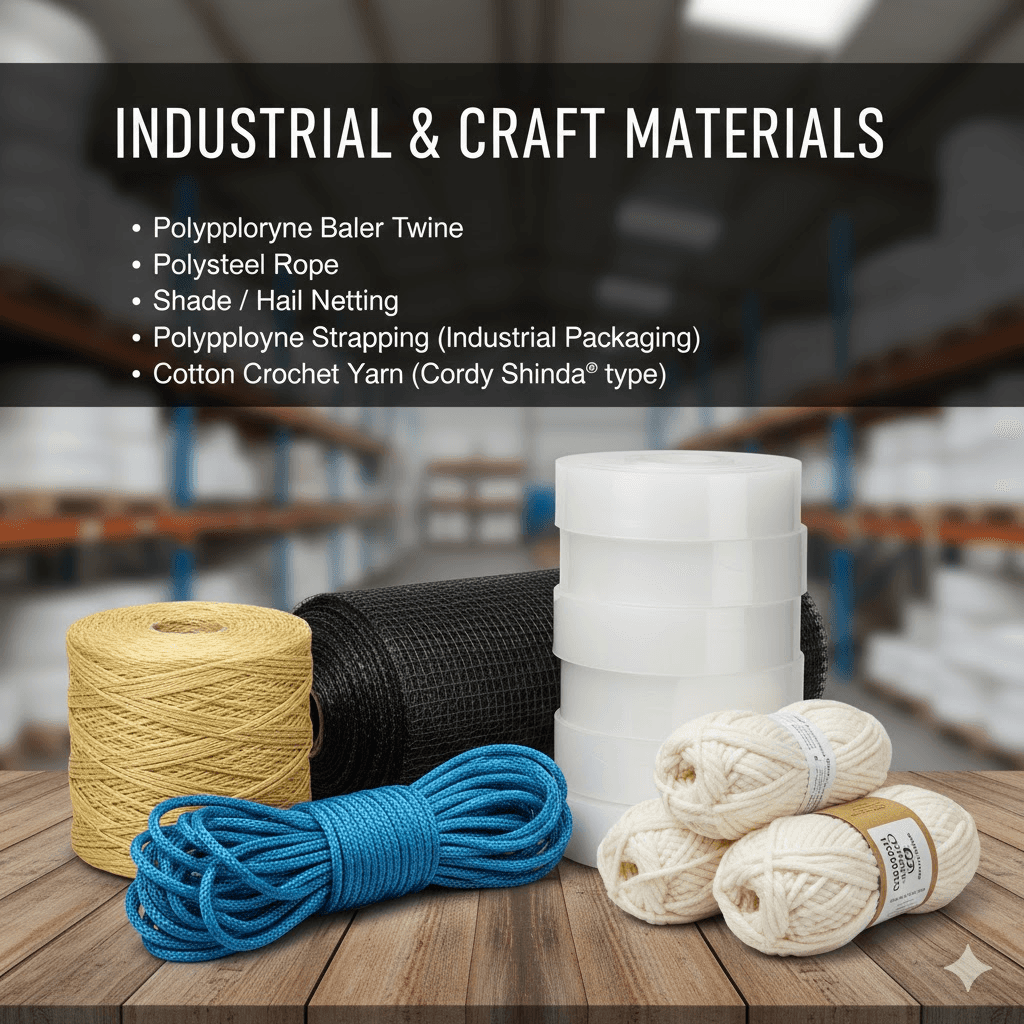
Walk into any agricultural warehouse, marine supply depot, or packaging facility, and you'll find them everywhere—twines holding hay bales together, ropes securing cargo, nets protecting crops from hail. These everyday products share something critical: they all start with perfectly twisted yarn.
For manufacturers producing polypropylene twines, cotton cords, polyester ropes, shade nets, or industrial strapping, that initial yarn quality makes all the difference. It's what separates a reliable product from one that breaks under pressure.
At Meera Industries, we've spent decades helping manufacturers achieve exactly that—consistent, high-strength yarns that perform when it matters most.
The Growing Demand for High-Performance Industrial Yarns
The market has evolved significantly. Today's manufacturers need:
High-tensile agricultural twines that won't snap during baling operations
UV-resistant ropes that withstand years of outdoor exposure
Lightweight yet durable polyethylene netting for packaging
Strong bag-stitching threads that hold under industrial loads
Customized horticultural nets for modern farming
Technical polypropylene strapping for secure cargo transport
Each application demands precision-engineered yarn where twist consistency directly impacts final product performance.
Why Twist Quality Matters More Than You Think
Whether you're working with cotton, polyester, nylon, HDPE, polypropylene, or monofilament yarns, the twist profile controls everything:
Tensile strength – How much load the yarn can handle
Knotting ability – Critical for twines and ropes
Environmental resistance – UV, moisture, and chemical exposure
Shock absorption – Especially important for marine and outdoor applications
Flexibility versus stiffness – Determines usability
Processing compatibility – How well it works in downstream equipment
Poor twisting creates real problems: frequent breakages, inconsistent thickness, loose filaments, winding difficulties, weak knots, and shortened product life.
This is precisely why manufacturers are turning to Meera's precision twisting technology—machinery built specifically for technical textiles, industrial ropes, agricultural nets, and packaging yarns.
Agricultural Twines: From Field to Factory
Best Meera Solutions: DTX-300 High-Speed Direct Twister, R-200 Ring Twister, FT-260 Two-for-One Twister, CWXX-250 Coreless Rewinder
Agricultural twines face tough conditions. They need to withstand outdoor storage, resist moisture, maintain consistent knot strength, and unwind smoothly in high-speed baling equipment.
Our DTX-300 delivers exceptionally consistent denier and twist—the kind of precision that prevents baler downtime during harvest season. The R-200 provides beautiful ring-twist quality for cotton-based twines used in curing, tying, and baling operations.
What really sets our equipment apart for agricultural applications? The CWXX-250 Coreless Rewinder produces large, dense packages that feed continuously into baling machines without constant changeovers—a significant productivity advantage during peak seasons.
Rope Manufacturing: Where Strength Meets Precision
Best Meera Solutions: DTX-300, FT-260, R-200, TPRS Series for heavy deniers
Rope yarns demand exceptional qualities: high tenacity for load-bearing, shock-load absorption for safety-critical applications, uniform twist across large deniers, and precision for multi-ply constructions.
Our TPRS-25 and TPRS-50 heavy-denier twisting machines were specifically engineered with rope manufacturers in mind—whether you're producing marine-grade lines, outdoor adventure gear, or industrial lifting equipment.
The DTX-300 handles polypropylene and polyethylene monofilaments beautifully, creating bulk packages perfect for stranding and laying operations. Meanwhile, the FT-260 excels with multifilament polyester and nylon, ensuring the abrasion resistance modern rope applications require.
Netting Production: Precision at Scale
Best Meera Solutions: DTX-300, FT-260, CWX-250/CWXX-250
Netting applications—from agricultural shade structures to aquaculture—require consistent monofilament appearance, uniform diameter, and stable twist to prevent tearing under load.
Whether you're producing shade nets for greenhouse operations, hail protection for orchards, trellis netting for vineyards, or aquaculture nets, our twisting machines deliver identical TPM (twists per meter) in every thread, perfect lay for net-making machinery, and stable packages for conversion lines.
The result? Nets that resist UV degradation, withstand tension, maintain mesh uniformity, and support long-life outdoor applications—exactly what modern agriculture and aquaculture demand.
Packaging and Industrial Applications
Best Meera Solutions: DTX-300, CWXX-250 Coreless Rewinder, R-200
Packaging nets for potatoes, citrus, onions, and other produce need abrasion-resistant yarn with strong twist structure. Industrial strapping requires extremely high tensile strength with zero twist variation.
Meera machines consistently deliver industrial-grade yarns ready for extrusion, weaving, knitting, and bonding operations—the foundation of reliable packaging materials.
Cotton Craft Yarns: Where Softness Meets Consistency
Best Meera Solutions: R-200 Ring Twister, FT-260, CWX-250 Rewinder
The craft market has unique demands: soft, balanced twist for comfortable handling, consistent dye uptake for vibrant colors, multiple TPM options for different applications, and smooth winding suitable for both hand and machine work.
Our R-200 delivers a world-class ring-spun finish—ideal for crochet yarns, piping cords, polished cotton string, and specialty craft products where touch and appearance matter.
What Sets Meera Apart
Built for Real-World Production
Our machines run 24/7 in demanding industrial environments. They're built to last, with minimized maintenance requirements and maximum uptime—critical when production schedules are tight.
The Coreless Advantage
The CWXX-250's ultra-dense, coreless packages offer real advantages for baler twines, netting yarn, packaging applications, and rope input yarn—reducing changeover frequency and increasing throughput.
Energy Efficiency That Impacts Your Bottom Line
Every Meera machine is designed for reduced power consumption—essential when you're running multiple lines at high volume.
True Material Versatility
Our equipment handles the full range: PP, PE, HDPE, polysteel, polyester, nylon, cotton, blends, monofilament, and multifilament. One machine platform, multiple material capabilities.
Technical Textile Performance
These aren't general-purpose machines—they're engineered specifically for the twist quality that technical textile applications demand across agriculture, marine, packaging, logistics, horticulture, aquaculture, and industrial strapping sectors.
Your Yarn Quality Determines Your Product Reputation
Whether you manufacture agricultural twines, marine ropes, braided cords, packaging nets, shade structures, horticultural systems, or industrial strapping, everything starts with your yarn.
The manufacturers we work with choose Meera for practical reasons: consistent quality that reduces customer complaints, higher productivity that improves profitability, longer-lasting final products that build brand reputation, and reduced operating costs that strengthen competitiveness.
Ready to Strengthen Your Production?
Meera Industries provides twisting solutions trusted worldwide for technical textiles, heavy-denier applications, and high-output industrial yarn production.
The right twisting technology doesn't just improve your yarn—it transforms your entire manufacturing efficiency.
Contact Meera Industries today to discuss how our DTX-300, FT-260, R-200, CWX-250, CWXX-250, or TPRS series can elevate your production capabilities.
Frequently Asked Questions:
General Questions
Q. What does Meera Industries manufacture?
Meera Industries Limited manufactures precision twisting machines and textile machinery for producing high-performance yarns used in twines, ropes, netting, packaging materials, and industrial strapping. Their primary products include the DTX-300 High-Speed Direct Twister, FT-260 Two-for-One Twister, R-200 Ring Twister, CWX-250/CWXX-250 Coreless Rewinder, and TPRS series (TPRS-19/25/50) for heavy-denier applications.
Q. Who are Meera Industries' primary customers?
Meera's customers are manufacturers who produce agricultural twines (baler twines, bag-stitching threads), ropes (polysteel, polyethylene, polyester, cotton), technical netting (shade nets, hail nets, horticultural nets, aquaculture nets), packaging materials (nets and strapping), and cotton craft yarns (crochet, piping cords).
Q. What industries does Meera Industries serve?
Meera serves multiple industries including agriculture (baling, packaging), marine (ropes, cordage), horticulture (shade and trellis systems), aquaculture (fishing nets), packaging (industrial strapping, produce nets), logistics (cargo securing), and textiles/crafts (cotton yarns).
Product-Specific Questions
Q. What is the DTX-300 and what is it used for?
The DTX-300 is Meera's High-Speed Direct Twisting machine designed for producing consistent, high-quality twisted yarns. It excels at processing polypropylene (PP) and polyethylene (PE) monofilaments and is ideal for manufacturing agricultural baler twines, netting yarns, packaging materials, and rope input yarns. It delivers exceptional denier consistency and twist precision at high speeds.
Q. What applications is the FT-260 Two-for-One Twister best suited for?
The FT-260 is optimal for multifilament polyester and nylon yarns requiring superior twist quality. It's commonly used for producing polyester braided rope yarns, bag-stitching threads, technical netting yarns, and cotton craft applications. The two-for-one twisting mechanism provides efficiency and consistent quality.
Q. What makes the R-200 Ring Twister special?
The R-200 Ring Twister delivers world-class ring-spun finish quality, making it ideal for cotton-based applications including cotton baling yarn, crochet yarn, piping cords, cotton braided rope components, and specialty craft yarns. It provides the soft, balanced twist that cotton products require while maintaining excellent dye uptake consistency.
Q. What is the advantage of the CWXX-250 Coreless Rewinder?
The CWXX-250 produces ultra-dense, coreless packages that offer significant advantages for high-volume production. These larger packages reduce changeover frequency in continuous operations like baling machines, increase throughput, improve material handling efficiency, and are particularly valuable for agricultural twines, netting yarn, packaging applications, and rope input materials.
Q. What are the TPRS series machines designed for?
The TPRS series (TPRS-19, TPRS-25, TPRS-50) are heavy-denier twisting solutions specifically engineered for rope manufacturers and applications requiring large yarn deniers. They handle high-tenacity outdoor cords, marine-grade rope yarns, industrial lifting equipment inputs, and polysteel rope production with precision and consistency.
Technical Questions
Q. What materials can Meera's twisting machines process?
Meera machines handle a comprehensive range of materials including polypropylene (PP), polyethylene (PE), high-density polyethylene (HDPE), polysteel, polyester, nylon, cotton, cotton blends, and both monofilament and multifilament constructions.
Q. Why is twist quality important for twines and ropes?
Twist quality directly determines tensile strength, knot strength, resistance to UV/moisture/chemicals, shock-load absorption capacity, flexibility versus stiffness balance, processing compatibility with downstream equipment, and overall product durability and lifespan.
Q. What does TPM mean and why does it matter?
TPM stands for Twists Per Meter, which measures how many times the yarn is twisted within one meter of length. Consistent TPM is critical because it ensures uniform strength throughout the yarn, prevents weak spots that cause breakage, maintains consistent product performance, and enables reliable processing in net-making, rope-laying, and weaving operations.
Q. What is the difference between monofilament and multifilament yarns?
Monofilament yarn consists of a single continuous filament (like fishing line), offering stiffness, abrasion resistance, and uniformity—ideal for netting and certain packaging applications. Multifilament yarn consists of multiple fine filaments bundled together, providing flexibility, softness, higher strength, and better shock absorption—preferred for ropes, bag stitching, and craft yarns.
Application-Specific Questions
Q. Which Meera machine is best for agricultural baler twine production?
The DTX-300 combined with the CWXX-250 Coreless Rewinder is the optimal setup for baler twine production. The DTX-300 provides consistent twist and denier control, while the CWXX-250 creates large, dense packages that feed continuously into baling equipment, minimizing downtime during harvest seasons.
Q. What equipment should rope manufacturers choose?
Rope manufacturers should consider the TPRS-25 or TPRS-50 for heavy-denier applications, the DTX-300 for PP/PE monofilament rope yarns, and the FT-260 for multifilament polyester/nylon rope components. The choice depends on rope type, material, and denier requirements.
Q. How does Meera support shade net and agricultural netting production?
Meera's DTX-300 and FT-260 machines produce netting yarns with consistent monofilament appearance, uniform diameter, and stable twist essential for preventing tears under load. These machines ensure UV-resistant yarns that maintain mesh uniformity for shade houses, hail protection, trellis systems, and aquaculture applications.
Q. Which machine produces the best cotton craft yarns?
The R-200 Ring Twister is specifically designed for cotton craft applications. It delivers the soft, balanced twist required for crochet yarn, piping cords, and specialty cotton products while ensuring consistent color uptake and smooth winding suitable for both hand and machine work.
Business & Operational Questions
Q. What are the main benefits of choosing Meera twisting machines?
Key benefits include consistent quality that reduces customer complaints, higher productivity improving profitability, energy-efficient operation reducing costs, 24/7 industrial durability with minimal maintenance, material versatility across PP/PE/cotton/polyester/nylon, and technical textile performance meeting demanding specifications.
Q. Are Meera machines energy efficient?
Yes, all Meera machines are designed with reduced power consumption, which is essential for manufacturers running multiple production lines at high volume. Energy efficiency directly impacts operational costs and profitability.
Q. Can one machine handle multiple materials?
Yes, Meera's machines offer true material versatility. For example, the DTX-300 can process both PP and PE monofilaments, while the FT-260 handles various multifilament materials including polyester, nylon, and cotton blends.
Q. What kind of maintenance do Meera machines require?
Meera machines are built for 24/7 industrial operation with minimized maintenance requirements. They're engineered for maximum uptime, which is critical when production schedules are tight and seasonal demands peak.
Market & Trends Questions
Q. What trends are driving demand for better twisting technology?
Key trends include increasing demand for high-tensile agricultural twines for modern baling equipment, UV-stabilized outdoor and marine products requiring longer lifespans, lightweight yet durable packaging materials, customized horticultural and aquaculture netting solutions, and technical industrial strapping for secure cargo transport.
Q. Why is UV resistance important for outdoor applications?
UV resistance prevents degradation from sun exposure, which is critical for products like shade nets, agricultural netting, marine ropes, and outdoor strapping that must maintain strength and integrity over months or years of continuous outdoor use.
Q. What makes a good packaging net yarn?
Good packaging net yarn requires abrasion resistance to withstand handling, strong twist structure to prevent unraveling, consistent mechanical properties for reliable processing, and appropriate flexibility to conform to packaged goods without breaking.
Getting Started
Q. How can manufacturers learn more about Meera's solutions?
Manufacturers can contact Meera Industries directly to discuss their specific production requirements. Meera's team can recommend the optimal machine configuration based on material type, desired output, product applications, and production volume.
Q. Does Meera provide support for machine selection?
Yes, Meera Industries works with manufacturers to understand their specific needs—whether producing agricultural twines, marine ropes, netting, or industrial strapping—and recommends the appropriate twisting technology for their applications.
Q. What should manufacturers consider when upgrading twisting equipment?
Key considerations include current and planned production materials, required output volume and speed, final product applications and quality requirements, available floor space and power capacity, downstream processing equipment compatibility, and desired package sizes and formats.