Technical Yarns for Slings, Ropes, Filters & Acoustic Panels – Powered by Meera Twisting Technology
Modern infrastructure quietly depends on highly engineered yarns.
Behind every lifting sling in a warehouse, every mooring rope on a ship, every filter in an HVAC system, and every polyester acoustic panel in a boardroom lies a backbone of twisted technical yarns.
This article connects four fast-growing product families:
Industrial slings & webbings
Ropes & cordages
Dry & wet filter media
Polyester acoustic panels
…and shows how Meera’s FT-210, R-200 and TPRX-50 twisting platforms help manufacturers in India and worldwide produce the yarns that feed these markets.
Market snapshot – four technical-yarn opportunities
Based on industry data from the featured segments:
Webbings & industrial slings
Global webbing market: ~USD 4.17 billion in 2023, projected to reach ~USD 6.70 billion by 2033
CAGR: ~4.4% (2024–2030), ~5.1% (2025–2033)
India’s specific numbers are not always published, but demand growth is strong in lifting, cargo securing and safety gear.
Synthetic ropes & cordages
Global synthetic rope market: around USD 2.06 billion in 2024, expected to reach ~USD 3.43 billion by 2032, CAGR ~6.6%
Indian rope market (all types): ~USD 989.6 million in 2021, projected to ~USD 1.855 billion by 2030, CAGR ~7.2%
Dry & wet filter products
Industry estimates suggest 2,500–3,000 tonnes of filtration products are sold annually in India.
Domestic output is strong, but niche and high-performance filters continue to be imported.
Polyester acoustic panels
A smaller but rapidly growing subset of the acoustic-panel market used in building construction and automotive NVH (noise, vibration & harshness).
A CAGR in the 10–15% range is widely considered realistic for this specific segment.
Across all four, there is one common theme: high-tenacity, precisely twisted synthetic yarns – a space where Meera Industries has specialised for decades.
Industrial Slings & Webbings – safer lifting with engineered polyester yarns
Materials and yarn constructions
Industrial slings and webbings in India are dominated by polyester webbing. Key yarn types include:
Polyester multifilament webbing yarns – the workhorse for lifting slings thanks to their strength, abrasion resistance and low stretch.
Blends of polyester multifilament with high-strength polyolefin tapes – newer constructions that improve strength-to-weight ratio and cut resistance.
High tenacity polyester & nylon yarns – for edge protection, reinforcing selvedges and accessories.
Standards such as IS 15041 (flat woven webbing slings of man-made fibres) and IS 18118 (flat woven webbing slings from blends of polyester multifilament and high-strength polyolefin tapes) define key performance requirements.
To meet these standards, webbing manufacturers need uniform twist, balanced torque and consistent elongation in their yarns.
How Meera machines fit
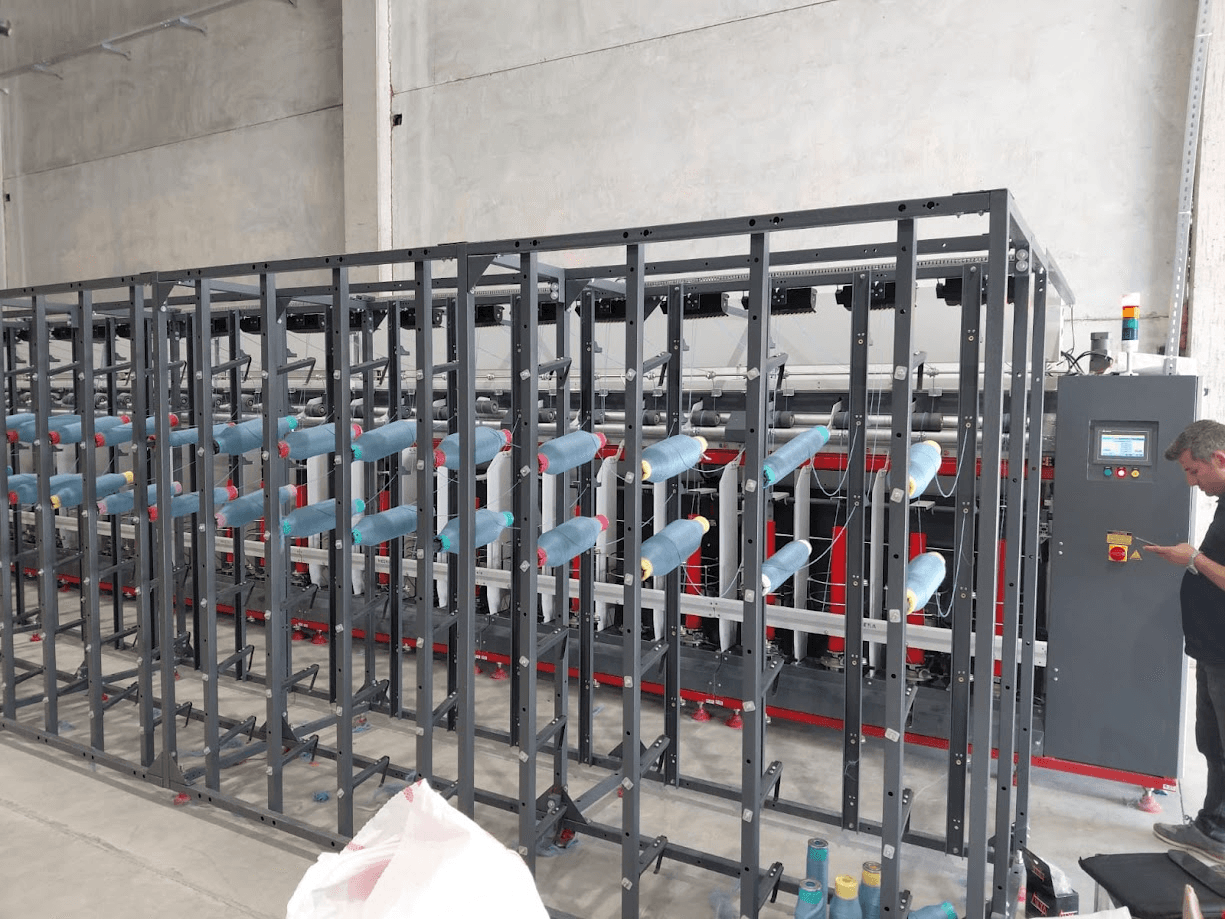
FT-210 Two-for-One Twister
Ideal for high-speed production of polyester and nylon multifilament yarns in the 210–6000 denier range. Precise tension control and electronic drive systems help maintain low CV in denier and twist – critical for even webbing construction.R-200 Ring Twister
Perfect for high-tenacity sewing, edge cord and load-bearing yarns used in heavy slings, round slings and tie-down assemblies. The ring system delivers compact, strong yarns with excellent fatigue resistance.TPRX-50 Ply & Cable Twister
Used to ply multiple ends into load-bearing cords, eye loops and core yarns for heavy-lift webbing slings. Multi-step cabling can be consolidated into efficient, controlled twisting routes.
By combining FT-210 for primary twist, R-200 for compactness and TPRX-50 for cabling, manufacturers can build a complete yarn line for lifting slings and webbings, compliant with BIS standards and ready for smart-sling innovations such as sensor-integrated tapes.
Ropes & Cordages – from fishing lines to smart offshore ropes
Yarn types and applications
India’s rope and cordage industry uses both natural and synthetic fibres:
Natural fibres: jute, coir, hemp, sisal, manila hemp – often for agriculture, fishing and traditional ropes.
Synthetic fibres:
Polypropylene & high-tenacity polyolefin tapes – lightweight, floating ropes for marine and packaging.
Nylon & polyester – mooring ropes, lifting and towing, safety lines.
Ultra-high-molecular-weight polyethylene (UHMWPE) fibres such as Dyneema® and Spectra®, aramids like Kevlar® and Technora®, and high-modulus fibres like Zylon® – for high-performance offshore, winch lines and industrial hoisting.
Key trends include:
Synthetic alternatives to steel wire ropes – up to ~80% lighter and corrosion-resistant.
Smart ropes with fibre-optic sensors, RFID tags and embedded electronics for real-time load and fatigue monitoring.
Self-healing and nano-coated ropes that resist abrasion and chemicals.
Eco-materials using hemp, coir, recycled PET and biodegradable composites.
Meera as technology partner for rope yarns
Rope makers need balanced ply constructions, precise S/Z combinations and controlled shrinkage. Meera platforms support this:
FT-210 – first-stage twist for PP, polyester and nylon filament yarns for small-diameter braided and laid ropes.
R-200 – high-tenacity ring-twisted yarns for core / jacket applications where fatigue life is critical (e.g. winch ropes, rescue lines).
TPRX-50 – the workhorse for plying and cabling 2–48 ends into rope yarns. Adjustable lay, direction and tension profiles allow tailoring for marine, offshore, mining, construction and safety ropes.
With these machines, manufacturers can address both volume segments (general-purpose synthetic ropes) and specialised niches (smart ropes, high-performance UHMWPE/aramid ropes, cultural and artisan export products).
Dry & Wet Filters – fine denier yarns for clean air & liquids
Filter yarns and constructions
For dry and wet filtration used in HVAC, industrial dust collection, liquid process filters and automotive applications, Indian producers typically rely on:
Polyester, nylon and polypropylene fibres / yarns – for standard filter media.
Fiberglass yarns – where high temperature resistance is needed.
Specialty fibres such as aramid and PTFE – imported for hot-gas filtration, chemical resistance and ultra-low emissions.
Demand in India already reaches 2,500–3,000 tonnes of filtration products per year, with domestic output covering most mainstream needs. However, niche and advanced filter fabrics still tend to be imported due to:
Higher performance requirements (fine dust, aggressive chemicals, high temperatures).
Limited availability of locally twisted specialty yarns.
Gaps in specialised testing and certification.
How Meera twisting helps filtration specialists
FT-210 handles fine denier polyester and nylon yarns for spun-bond / woven filter fabrics. Precision twist improves fibre packing and dust cake release.
R-200 can twist fiberglass, aramid and PTFE yarns with controlled ballooning and low tension, helping to maintain fibre integrity and minimise filament breaks.
TPRX-50 is ideal for multi-ply filter sewing threads and support yarns, providing the strength and dimensional stability needed in pleated filter packs and filter pockets.
When combined with proper weaving/knitting and finishing, Meera-twisted yarns support the shift from commodity filter fabrics to high-efficiency, longer-life filtration solutions.
Polyester Acoustic Panels – sound absorption from recycled fibre
Market & material landscape
Polyester acoustic panels are used in:
Offices, schools, cinemas and auditoriums
Recording studios and home theatres
Automotive interiors and NVH applications
Unlike traditional glass wool or mineral fibre panels, polyester panels are clean-handling, lightweight, and often made from recycled PET / PSF.
In India:
Current capacity is broadly sufficient for domestic demand, but
Many manufacturers still depend on imported fibres, especially recycled PSF and low-melt PSF, due to quality consistency issues.
Exports are presently <5% of output, leaving ample headroom for growth.
There is a shortage of acoustic testing labs with global-standard capabilities, so panel makers must rely on careful raw-material selection and internal R&D.
Role of twisted yarns
Even though acoustic panels are usually non-woven boards, fibre quality and pre-twisted yarns matter in:
Surface fabrics and decorative quilting
Structural stitching and reinforcement
Hybrid panels combining woven / knitted covers with non-woven cores
Meera’s machines support this by:
Using FT-210 to twist fine denier polyester filament yarns used in surface fabrics and quilting.
Using R-200 for high-tenacity sewing and mounting threads that hold panels securely in frames or vehicles.
Using TPRX-50 for multi-ply core stitching yarns used in complex acoustic composites.
As more builders and OEMs shift towards sustainable, recycled polyester acoustic solutions, having a reliable technical-yarn partner in India becomes a strategic advantage.
Why choose Meera FT-210, R-200 & TPRX-50 for technical yarns?
Whether you make slings, ropes, filters or acoustic panels, your competitive edge lies in controlling yarn properties at the twist stage.
Meera value propositions:
Application breadth – same platforms can run polyester, nylon, polypropylene, UHMWPE, aramid, PTFE, fiberglass and recycled PET with recipe-based settings.
Process integration – TFO twisting, ring twisting and ply/cabling on dedicated machines that talk to your upstream creels and downstream winders.
Consistent quality – precise electronic drives, advanced traverse systems and intelligent tension control keep twist, elongation and shrinkage within tight limits.
Compliance ready – yarns produced on Meera machines are engineered to help you meet BIS / IS requirements for slings, webbings, ropes and filtration fabrics when combined with correct material and testing practices.
Project mindset – Meera can work as a technology partner, from machine selection and layout to trial recipes for new yarns (smart ropes, high-temperature filter media, eco-friendly acoustic panels).
Glossary of Key Technical Terms
Technical yarn – a yarn engineered for functional performance (strength, heat resistance, chemical resistance, safety) rather than fashion or aesthetics.
Webbing – a flat woven tape, usually of polyester or nylon, used for lifting slings, seat belts and tie-downs.
High-tenacity yarn – yarn produced from specially oriented polymers and optimised twist to deliver very high tensile strength per denier.
Polyolefin tape yarn – flat, ribbon-like yarn extruded from polypropylene or other polyolefins, often used in ropes and webbings.
UHMWPE – ultra-high-molecular-weight polyethylene, an extremely strong, low-density fibre used for high-performance ropes.
Aramid – a class of heat-resistant, strong synthetic fibres (e.g., Kevlar, Technora) used in protective clothing, ropes and filtration.
PTFE yarn – yarn made from polytetrafluoroethylene for chemical- and heat-resistant filtration media.
Dry & wet filter media – technical textiles used to filter air (dry) or liquids (wet) in industrial and HVAC systems.
Acoustic panel – a board or panel designed to absorb or diffuse sound, often made from polyester fibres, glass fibre or foam.
TFO (Two-for-One) twisting – a twisting process in which two yarns are twisted in one pass, improving productivity and twist uniformity.
FAQ – Technical yarns & Meera twisting solutions
Q. Which yarns are most common for industrial lifting slings and webbings?
Most lifting slings use polyester multifilament webbing yarns, sometimes blended with high-strength polyolefin tapes for added strength and cut resistance. Nylon is used where extra elasticity is needed.
Q. What makes a rope “high-performance” compared to a normal synthetic rope?
High-performance ropes use fibres like UHMWPE, aramid or advanced polyester constructions, often in multi-ply designs. They offer superior strength-to-weight ratio, low creep, high fatigue life and improved safety compared to commodity PP ropes.
Q. Can Meera machines process specialty fibres such as aramid, PTFE or fiberglass?
Yes. With suitable creel, tension and balloon control, R-200 and FT-210 can process many specialty fibres, while TPRX-50 can ply them into robust sewing and support yarns for filtration and industrial applications.
Q. How do technical yarns influence the performance of dry and wet filters?
Twist level, fibre type and yarn structure determine pore size, dust cake behaviour, pressure drop and chemical resistance. Well-designed twisted yarns help filters last longer, clean easier and meet stricter emission norms.
Q. Why are polyester acoustic panels often made from recycled PET?
Recycled PET / PSF allows manufacturers to reduce environmental impact, create panels with good acoustic absorption and maintain a circular material economy. Consistent fibre quality, however, depends on reliable spinning and twisting routes.
Q. What BIS / IS standards should yarn and product makers be aware of?
For example, IS 15041 and IS 18118 for industrial webbing slings and several IS standards for natural and synthetic ropes. While many norms address finished products, yarn producers must design twist, strength and elongation to help their customers pass these tests.
Q. How does Meera support new product development, such as smart ropes or eco-friendly panels?
Meera works as a technology partner, offering machine trials, twist-design support and scale-up guidance so that customers can commercialise new yarns – from sensor-integrated smart ropes to eco-friendly filter media and acoustic composites.