Why Your Yarn Quality Starts With the Right Twisting Machine (And How to Choose One)
You know that feeling when you're running a textile production line and the yarn keeps breaking? Or when your fabric comes out inconsistent, no matter how many times you adjust the settings?
Here's the thing most people don't realize: the quality of your final fabric is decided long before weaving or knitting begins. It all comes down to how well your yarn is twisted.
I've spent years watching textile manufacturers struggle with the same issues—weak yarns, inconsistent TPM (twists per meter), packages that don't unwind smoothly, and machines that just can't handle heavy-denier technical yarns.
That's why I want to walk you through something different today. Not just another product catalog, but a real guide to understanding which twisting technology actually works for different textile applications.
What Actually Makes Yarn "Good"?
Before we dive into machines, let's get clear on what we're trying to achieve.
Good yarn isn't just about thickness or color. It's about:
Strength – Can it handle the stress of weaving at 800 RPM?
Uniformity – Does every meter have the same twist and tension?
Hand feel – Is it smooth enough for fashion fabrics or grippy enough for industrial use?
Durability – Will it survive repeated washing, UV exposure, or friction?
All of these qualities come from one place: precise twist insertion.
And that's where most generic twisting machines fall short.
The Real Problem With Most Twisting Machines
Here's what I hear from textile manufacturers constantly:
"We bought a twisting machine, but it can't handle our polyester deniers."
"The packages come out uneven, so we waste time rewinding."
"Our automotive clients rejected our yarn because the twist isn't consistent enough."
The root cause? Trying to force one machine to do everything.
A machine designed for fine apparel yarns will struggle with 3000D technical yarns. A basic ring twister won't give you the speed needed for high-volume sportswear production. And if you're producing medical textiles, you need ultra-clean yarn passage that most machines simply don't offer.
Let's Break Down Real Applications (And Which Machines Actually Work)
1. Fashion & Apparel: When Softness Meets Strength
If you're making shirts, dresses, sarees, or fashion garments, your yarn needs to feel good while staying strong enough for daily wear.
What you need:
Low hairiness for smooth fabric
Controlled bulk for drape
Consistent twist for uniform dyeing
Machines that work:
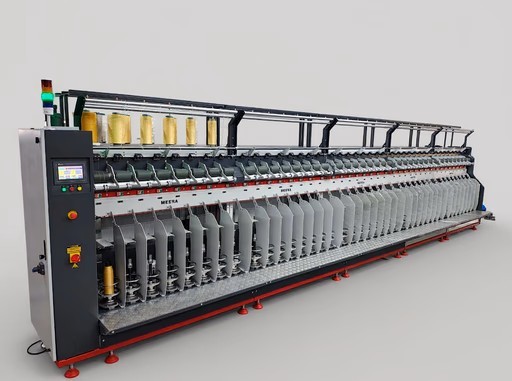
FT-260 Two-for-One Twister – This is your go-to for fine denier polyester, nylon, and viscose. The two-for-one mechanism means you get double the productivity without sacrificing precision. Perfect for anything from 75D to 300D.
R-200 Ring Twister – When you need ring-doubling for blended yarns or compact twisting for premium fabrics, this machine delivers clean, tight twist without overstressing the filament.
CWX-250 Coreless Rewinder – After twisting, you need perfect packages for warping and weaving. This rewinder ensures zero yarn damage and uniform tension across the entire package.
2. Sportswear & Activewear: Built for Movement
Athletic fabrics need to stretch, recover, wick moisture, and resist abrasion—all while feeling comfortable.
What you need:
High tenacity for compression wear
Elasticity with twist lock-in
Abrasion resistance for repeated flexing
Machines that work:
DTX-300 High-Speed Direct Twister – This is the workhorse for high-tenacity polyester and nylon used in performance gear. It handles speeds that traditional twisters can't match, giving you the output you need for large sportswear orders.
TPRS-19 / TPRS-25 One-Step Ply Twister – For compression leggings, athletic tapes, and multi-ply performance yarns, this machine does both plying and cabling in one pass. That means faster production and more consistent twist distribution.
3. Automotive Textiles: When Failure Isn't an Option
Seatbelts, airbags, upholstery—these aren't just fabrics. They're safety-critical components that need to perform under extreme conditions.
What you need:
Uniform load distribution
Thermal and abrasion resistance
Dimensional stability under stress
Heavy-denier capability (often 840D to 6000D)
Machines that work:
DTX-300 (Heavy-Denier Configuration) – Designed to handle the thickest, toughest yarns used in automotive applications. It maintains consistent TPM even at high deniers, which is critical for seatbelt webbing and airbag fabrics.
R-200 Heavy-Duty Ring Twister – For cabling and multi-ply reinforcement yarns where precision matters more than speed.
TPRS-50 High-Tenacity Ply Twister – Built specifically for safety-critical applications requiring exact twist control. Vibration-free operation ensures every meter meets spec.
4. Medical Textiles: Cleanliness Meets Precision
Medical gowns, surgical drapes, compression bandages—these products need to be strong, clean, and consistent through repeated sterilization cycles.
What you need:
Low hairiness to minimize bacteria retention
Strength for repeated washing and sterilization
Clean yarn passage
Precise tension control
Machines that work:
FT-260 – Ultra-clean yarn path makes this ideal for medical-grade polyester and nylon. The low-hairiness output is crucial for fabrics that need to meet hygiene standards.
DTX-300 – Perfect for polypropylene nonwoven stitching yarns and medical uniform fabrics where consistency is non-negotiable.
R-200 – When you're producing elastic medical bandages, the controlled twist insertion ensures proper compression properties.
5. Home Furnishings: Durability With Aesthetic Appeal
Upholstery, curtains, carpets, outdoor furniture fabrics—these textiles need to look good and last years.
What you need:
Bulk and body for cushioning
Pilling resistance
Shape retention
Color consistency
Machines that work:
DTX-300 – Handles PP and PET yarns commonly used in carpets and upholstery. High output with lower power consumption makes it economical for large-volume production.
TPRS-Series – For decorative multi-ply yarns and chenille-type products where texture matters.
CWX-Series Rewinders – Creates perfect packages for dyeing and weaving, ensuring uniform color uptake.
6. Industrial & Technical Textiles: Raw Strength
Ropes, cargo straps, geotextiles, filtration media, conveyor belts—these are the heavy-duty applications where yarn failure means real consequences.
What you need:
Zero slippage
High modulus
Chemical and UV resistance
Ability to handle 1000D to 6000D yarns
Machines that work:
DTX-300 – The heavy-denier champion. Consistently handles the thick, tough yarns needed for industrial applications.
TPRS-50 / TPRS-25 – For multi-ply ropes, straps, and reinforced composites where strength is everything.
CWXX-250 Coreless Rewinder – Creates the large take-up packages required by technical fabric manufacturers.
The Features That Actually Matter (Not Just Marketing Specs)
When you're comparing twisting machines, ignore the fluff. Here's what actually impacts your production:
Spindle Speed vs. Consistent TPM
High spindle speed sounds impressive, but if your TPM varies by 5% across the package, you've got problems. Look for machines with closed-loop tension control and precision drive systems.
Package Build Quality
A poorly built package will cause problems downstream—sloughing during unwinding, tension variations in weaving, dye defects. Machines with programmable traverse systems and precision winding drums eliminate these issues.
Vibration Control
This matters more than most people realize. Vibration causes yarn stress, increases breakage, and reduces spindle life. Balanced spindle design and vibration dampening systems aren't optional for serious production.
Thermal Stability
Friction creates heat. Heat affects twist. Machines with active cooling systems and ceramic guides maintain consistent performance even in long production runs.
Easy Threading and Maintenance
This isn't sexy, but it's real. If your operators spend 30 minutes threading each spindle after every break, you're losing money. Look for quick-threading systems and accessible service points.
How to Choose the Right Machine for Your Operation
Here's my straightforward decision framework:
Step 1: Define your primary yarn type
Fine denier apparel (75D-300D) → FT-260
Medium sportswear yarns (150D-600D) → DTX-300
Heavy technical yarns (600D-6000D) → DTX-300 or TPRS-50
Step 2: Consider your volume needs
Small batch, high variety → R-200 Ring Twister
High-volume single products → DTX-300
Multi-ply complex yarns → TPRS Series
Step 3: Think about your downstream process
Direct to weaving → CWX-250 Rewinder essential
Dyeing between steps → CWXX-250 for larger packages
Technical applications → Both twisting and rewinding precision critical
Step 4: Factor in your quality requirements
Medical/automotive → Zero-compromise precision (FT-260, DTX-300)
Fashion/home → Balance of quality and speed (FT-260, CWX-250)
Industrial → Raw strength and consistency (DTX-300, TPRS-50)
Why This Actually Matters for Your Business
Let me be direct: the right twisting machine pays for itself within the first year.
Here's how:
Reduced breakage = Less downtime, less waste
Consistent TPM = Fewer fabric rejects, happier customers
Higher speeds = More output per shift
Better packages = Smoother downstream processing
Lower maintenance = Fewer service calls, longer machine life
I've seen manufacturers cut their yarn rejection rate from 8% to under 1% just by switching to precision twisting equipment. That's real money.
The Bottom Line
You can't make great fabric from mediocre yarn. And you can't make consistent yarn without precise twisting.
Whether you're producing fashion garments, athletic wear, automotive components, medical textiles, home furnishings, or industrial ropes, your twisting machine is the foundation of your quality.
The good news? You don't need a different machine for every application. You need the right machine configured properly for your specific needs.
That's where companies like Meera Industries come in—offering everything from the FT-260 for fine work to the DTX-300 for heavy-duty applications, with rewinding and plying solutions to complete your production line.
Want to see which machine configuration works for your specific yarn and application? Most manufacturers are surprised to learn they're using the wrong setup—and equally surprised by how much improvement is possible with the right equipment.
The textile industry is moving toward higher quality, faster production, and more technical applications. Your twisting equipment needs to move with it.
Frequently Asked Questions
Q. What's the difference between ring twisting and two-for-one twisting?
Ring twisting uses a traditional ring-and-traveler system—it's slower but gives excellent control for specialty yarns and small batches. Two-for-one (TFO) twisting inserts two twists per spindle revolution, effectively doubling your production speed. TFO is ideal for high-volume production of standard yarns, while ring twisting excels at complex, specialized applications.
Q. How do I know what TPM (twists per meter) I need for my application?
TPM depends on your yarn denier and end use. As a general rule: apparel fabrics typically need 300-800 TPM for balance between strength and softness; sportswear and technical textiles often need 400-1200 TPM for higher strength; industrial ropes and straps may need 200-600 TPM to maintain flexibility while adding strength. The exact TPM also depends on whether you're doing S-twist or Z-twist, and whether it's single or multiple ply. Testing samples is always recommended.
Q. Can one twisting machine handle different denier ranges?
Most machines have an optimal range. The FT-260 works best from 75D to 600D, while the DTX-300 can handle 150D up to 6000D depending on configuration. Trying to run 100D yarn on a machine designed for 3000D technical yarn will give you poor results. Similarly, heavy-denier yarns will struggle on machines built for fine filaments. Match your machine to your primary production range.
Q. Why do my packages unwind unevenly during weaving?
This usually comes down to three issues: inconsistent tension during winding, poor traverse pattern creating soft spots, or incorrect package density. A precision rewinder like the CWX-250 or CWXX-250 solves this by maintaining constant tension and creating a properly dense, cylindrical package. The traverse system ensures even distribution across the package width.
Q. What's the typical maintenance schedule for twisting machines?
Daily: Check yarn guides, clean sensors, inspect for loose yarns. Weekly: Lubricate spindles, check belt tension, clean dust from electronics. Monthly: Deep clean all guides and tension devices, check bearing wear, calibrate tension sensors. Annually: Full spindle rebuild, replace wear parts, professional calibration. Preventive maintenance dramatically reduces unexpected downtime and extends machine life by years.
Q. How much does yarn breakage cost, and can better equipment reduce it?
Yarn breakage is expensive—not just the wasted yarn, but the downtime for rethreading, the labor cost, the downstream quality issues. If you're running 100 spindles and each breakage costs 10 minutes of downtime, reducing breakage from 5 breaks per hour to 1 break per hour saves you 6+ hours of productive time per day. Better tension control, proper spindle balancing, and quality guides can reduce breakage by 60-80%.
Q. What's the difference between direct twisting (DTX) and indirect twisting?
Direct twisting takes yarn directly from a creel and twists it in one pass—it's faster and uses less floor space. Indirect twisting (like ring twisting) typically takes the yarn from cones and re-packages it while twisting. Direct twisting (DTX-300) is ideal for high-volume production where speed matters. Indirect methods offer more control for specialty applications or when you need to combine twisting with other processes.
Q. Do I need a separate rewinder, or can I weave directly from twist packages?
For small-scale production or testing, you can sometimes weave directly from twist packages. For serious production, you absolutely need proper rewinding. Here's why: twist packages often have tension variations, the package size may not suit your warping beam, and the traverse pattern from twisting isn't optimal for unwinding at high speeds. A dedicated rewinder creates uniform packages that minimize downtime and quality issues.
Q. How do I choose between the TPRS series machines (TPRS-19, TPRS-25, TPRS-50)?
The number indicates the spindle capacity and denier range. TPRS-19 is perfect for lighter multi-ply yarns used in fashion and sportswear (up to 600D). TPRS-25 handles medium technical applications (up to 1500D). TPRS-50 is your heavy-duty solution for industrial ropes, straps, and reinforcement yarns (up to 6000D). Choose based on your primary denier range and whether you need one-step plying and cabling.
Q. What certifications or standards should I look for in twisting equipment for medical or automotive textiles?
For automotive applications, look for machines capable of meeting ISO 13934 (tensile strength), ISO 9073 (nonwovens), and the specific OEM requirements of automotive manufacturers. For medical textiles, you'll want equipment with documentation for cleanroom compatibility, consistent performance for ISO 13485 quality systems, and the ability to produce yarns meeting FDA biocompatibility standards. The machine itself doesn't need certification, but it must produce yarns that consistently meet these standards.
Q. How long does it take to train operators on new twisting equipment?
Basic operation (threading, starting, stopping, package changes) can be learned in 1-2 days. Competent troubleshooting and tension adjustments typically take 2-4 weeks of supervised practice. Advanced optimization (speed settings, special yarn handling, preventive maintenance) usually requires 2-3 months. Modern machines with intuitive touchscreen interfaces and quick-threading systems significantly reduce the learning curve compared to older mechanical systems.
Q. What's the energy consumption difference between modern and older twisting machines?
Modern machines like the DTX-300 use 30-50% less energy than comparable machines from 15-20 years ago, thanks to efficient drive motors, optimized mechanical design, and better power management systems. For a 100-spindle operation running two shifts, this can mean savings of $15,000-30,000 annually in electricity costs alone. LED lighting, efficient cooling systems, and smart power-down features add to the savings.